The last chapter of this mythical saga came out 35 years ago
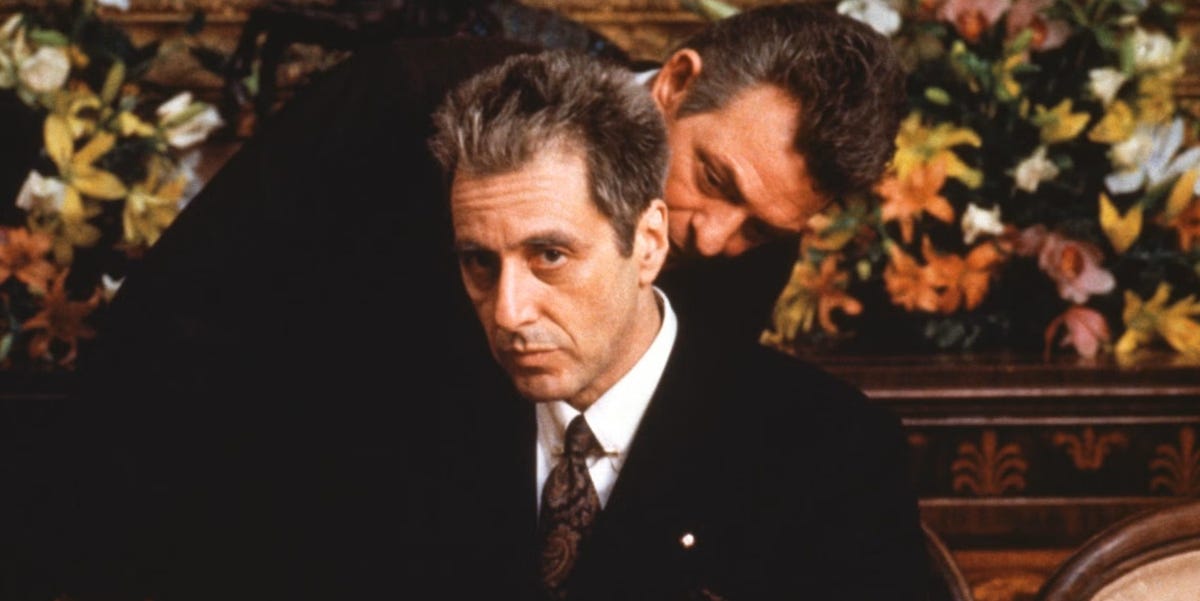
The Godfather – Part III after 35 years it continues to divide a lot. You will never find two people who think alike about the third and final chapter of Francis Ford Coppola’s saga. Of course, it wasn’t born under the best auspices this was clear from the beginning. After the first two chapters, Francis Ford Coppola considered the Michael Corleone saga closed, to the enormous disappointment of Paramountwhich with the first two chapters of the saga had raked in Oscars and money in abundance. However, he only considered a third chapter after having received a painful flop with A day long dreamwhich left him one step away from bankruptcy. He knew, of course, that he was entering dangerous territory. For 12 years, so many screenwriters, producers and aspiring writers had been proposing drafts, treatments and ideas, but none of them seemed to work, none of them were truly up to par with the world created by Mario Puzo, in fact pop culture mythology. When he wrote the screenplay, it was also influenced by production problems related to casting, duration and characterization desired by Paramount, in short it was anything but a profoundly authorial product like the first two chapters of the saga, whose genesis is still one of the most fascinating and complicated in the history of cinema. When he arrived in the room it became a real cinematic event.
The Godfather – Part III: lights and shadows of an ending

The Godfather – Part III it wasn’t even a project that Al Pacino particularly believed in, he too thought that Michael’s saga on the big screen no longer had much to say. Yet, the reality is that even here the New York champion was able to give us a sublime interpretation. We find Michael Corleone in 1979, aged, gloomy and besieged by diabetes. However, he managed to clean up his position, to break away almost completely from the Mafia he had dominated. Daughter Mary (Sofia Coppola) and son Anthony (Frank D’Ambrosio) have found their way, with his ex-wife Kay (Diane Keaton) relations are a little more relaxed. Michael decides to invest in the Vatican Bankan operation that should lead him to check the International Real Estate. However, he cannot imagine that that operation will put him in a nest of vipers between Rome, Sicily and the United States, of which Cardinal Gilday is the perfect image (Donal Donnelly), the Swiss banker Frederick Keinszig (Helmut Berger) and the political representative of the Mafia, Licio Lucchesi (Enzo Rebutti). As if that weren’t enough, the other American bosses, moved behind the scenes by the treacherous Don Altobello (Eli Wallach) want to enter the game. Michael will only have his sister Connie at his side (Talia Shire) and his nephew Vincent (Andy Garcia), Sonny’s illegitimate son, violent and irascible like his father. Between political maneuvers, conspiracies, murders and lies, the Godfather will find himself in a swamp difficult to decipher, with pitfalls around every corner.
A Michael forced to deal with himself

Michael Corleone in the first film of the saga he was a young veteran, who became the new head of the family partly by chance and partly by necessity. In the second, he had fully embraced the dark solitude of the role, building for himself a throne of blood (also that of his brother Fredo), the rank of Dark Prince of the family. Now in the third, Francis Ford Coppola gets him the bill. Alone, defeated by himselfhe doesn’t understand that that road had only one direction, he can’t get out of it because it’s impossible to do so, he’s prevented from doing so by his own power, by those around him. Daughter Mary is the purest part of his inheritance, which he knows is made of blood and sins, the same ones he will confide in Raf Vallonehere in the guise of a sympathetic Sicilian Cardinal. The trip to Sicily is the best part of the film, with a wild Eli Wallach, a Vincent who, from being a daredevil, an obstinate tamarro, is forced to mature, to become another Michael Corleone. Meanwhile, the plot is mounting, with the killer Mosca (Mario Donatone) who pursues his target, who continues to try to divide Vincent from Mary, a sinner obsessed with sin, but above all with finding an heir for his kingdom. The sins of the fathers fall on the children, but The Godfather – Part III it does moretalks to us about how it transforms, is inspired by Tangentopoli, the P2, the mysteries of Italy caged by the Mafia war, conspiracies and assassinations, to tell us about a mentality that is beyond mere crime. “You can have a mafia mentality without being affiliated” he said Giovanni Falcone.
A film that had to overcome too many difficulties to be perfect

The Godfather – Part III it is afflicted by a duplicity of vision and atmosphere, due to production choices that weakened the whole. Killing off Robert Duvall’s Tom Hagen for not wanting to pay him the right salary was a stupid mistake, but the casting problems for Mary Corleone they were something different. Julia Roberts glided by Pretty Womanthe poor one Rebecca Schaeffer instead she was killed by a madman. We then turned to Winona Ryder, another emerging name, but she suffered a nervous breakdown as soon as she arrived on set. It was Coppola who made the fundamental mistake of thinking that his daughter Sofia could play Mary. She was not and never has been an actressshe would instead have proven to be a very good director. But it was the weak link that influenced everything, she even had to be re-dubbed, when other actresses would have offered much different guarantees. Without a doubt, the absence of a unique counterpart, powerful as had happened in the other films of the saga, was another problem for The Godfather – Part III. The various dark and slimy figures that move around Michael, his financial operation, are no match for the powerful Bosses and various traitors with which he had to deal. They are jackals and do not go beyond this size. The connections then with the real news events, from the death of Roberto Calvi to P2 of Licio Gellifrom suspicions about the death of Pope John Paul I to the scandal of Banco Ambrosiano they were too telephoned and too crudely grafted not to arouse more than a few perplexities.
The weakest chapter but not without beauty

However, no one can forget that ending. Mosca who accidentally hits Mary instead of the Don, she who collapses on that staircase, Michael’s silent scream to the tune of Mascagni, still today it is one of the most memorable moments of Al Pacino’s career. The circle closes, Michael truly lost everythingin the end the Mafia, this “perilous rose” as it was defined by a repentant in Falcone, collected what it had to. He will die like his father, alone, in the garden, defeated by the life he has chosen. Certain, The Godfather – Part III it doesn’t compare with the other two, it couldn’t even due to the different artistic intention. But the direction of the American master is splendid, as is his ability to convey to us all the rot, the culture of death and deception, of this horrendous creature. The Godfather – Part III it will be a huge success at the box office, the critics will be mixed, between those who will appreciate the closure and those who will see it as a useless commercial operation. 7 Oscar nominations, all unsuccessful, a canceled sequel, but also due Director’s Cut very interesting. Definitely an interesting filmeven today after 35 years it is difficult to find a reason to hate it as well as a reason to love it deeply as happened with the first two, titanic, episodes. Since then, films about the mafia have changed, the narco-movie has become the new key to understanding that tale of greed, death and cunning. But this film certainly didn’t contribute to mythologizing that world at all, on the contrary.

I was born in Padua in 1985, always a great fan of sport, cinema and art. After twelve years as a professional coach and scout in the world of volleyball, I decided to pursue a career as a journalist.
Since 2016 I began to collaborate with various paper and online magazines, as a critic and correspondent at festivals such as Venice, Rome and Trieste Science Fiction.
I published with Viola Editrice “Cinema in the time of terror”analysis of post-9/11 cinema. For Esquire I cover cinema, television and sport, in particular I am a great fan of football, boxing, volleyball and tennis.
By virtue of this passion I also maintain a personal in-depth page on Facebook, entitled L’Attimo Vincente.
I believe in the weight of words, in irony, in always being true to one’s opinion when writing and in never thinking of being infallible.

Hi! I’m Renato Lopes, an electric vehicle enthusiast and the creator of this blog dedicated to the future of clean, smart, and sustainable mobility. My mission is to share accurate information, honest reviews, and practical tips about electric cars—from new EV releases and battery innovations to charging solutions and green driving habits. Whether you’re an EV owner, a curious reader, or someone planning to make the switch, this space was made for you.


Post Comment