Protesters demand governor’s resignation after deadly police raid in Rio de Janeiro
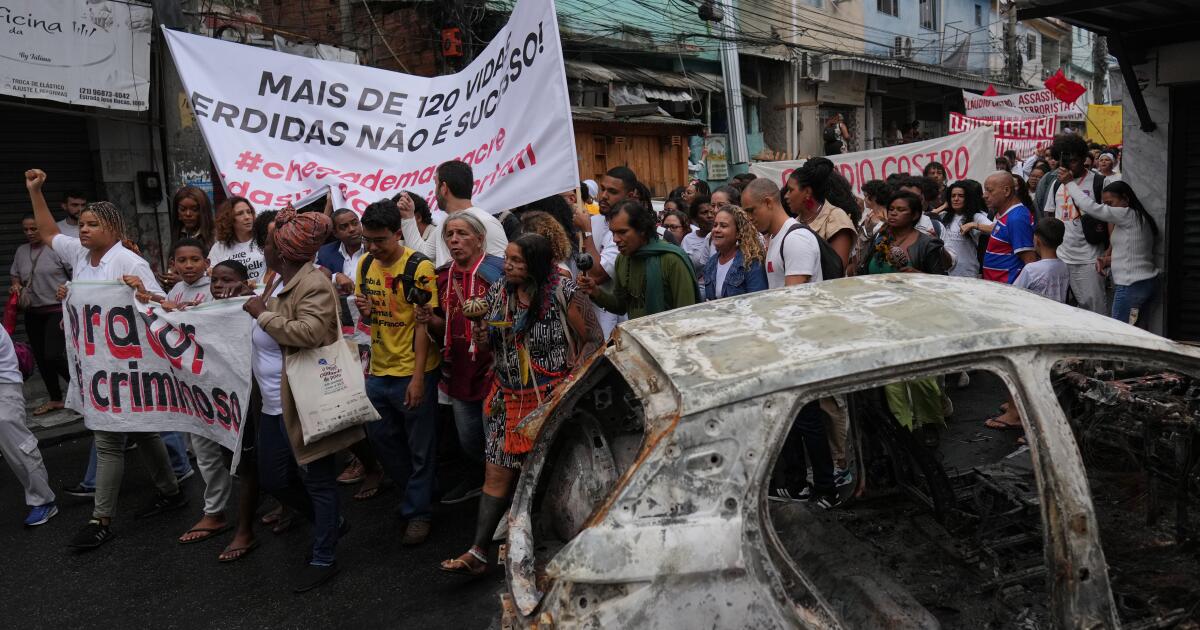
RIO DE JANEIRO — Hundreds of protesters marched Friday in one of the favelas where the deadliest police raid in Rio de Janeiro’s history took place, which left more than 100 dead, demanding the resignation of Rio state governor Cláudio Castro amid persistent outrage over the operation.
Local residents, politicians, activists, grieving mothers who lost their children in previous operations, and people from other Rio de Janeiro neighborhoods gathered to express their fury in Vila Cruzeiro, part of the Penha favela complex, where days earlier residents placed dozens of bodies on the ground that they had collected from a nearby green area after the raid.
At least 121 people were killed in Tuesday’s raid, including four police officers, according to police. The Rio public defender’s office says 132 people lost their lives.
“Coward, terrorist, murderer! His hands are stained with blood,” denounced Anne Caroline Dos Santos, 30, referring to Castro, an ally of former president Jair Bolsonaro and opponent of leftist president Luiz Inácio Lula da Silva.
Castro has accused the federal government of abandoning Rio in its fight against organized crime, a claim Lula’s government has refuted.
Dos Santos came from Brazil’s largest favela, Rocinha, in the southern part of Rio, to express his outrage. Like many other protesters, he accused police forces of committing torture and extrajudicial killings.
“Now mothers are fighting to recover the bodies of their children and bury them,” he said, adding that he had lost a friend in the operation.
Many stores have reopened since closing this week, but there were still signs on the streets of the recent events, including burned cars that were used as barricades against police entering the low-income neighborhood.
Many wore white, which one protester said symbolized their desire for peace, and some T-shirts had red hands printed on them. Others held signs that said, “stop killing us,” or wore stickers that read, “stop the massacres.”
“This is a disgrace for Brazil,” lamented Leandro Santiago, 44, who lives in Vila Cruzeiro and makes a living from his motorcycle, providing rides and making deliveries. “Nothing justifies this.”
Tuesday’s raid, carried out by some 2,500 police and soldiers, targeted the notorious Red Command gang in the Complexo de Alemão and Complexo da Penha favelas.
The stated objectives of the operation were to capture their leaders and limit the territorial expansion of the Red Command, which has increased its control over favelas in recent years but has also spread across Brazil, including into the Amazon rainforest.
The gang members met the police with gunshots and other retaliation, sparking scenes of chaos throughout the city.
Castro indicated Tuesday that Rio is at war against “narcoterrorism,” a term reminiscent of that used by the government of U.S. President Donald Trump in its campaign against drug smuggling in Latin America. He said the operation had been a success.
The state government said the dead were criminals who resisted the police.
But the death toll, the highest ever recorded in a police operation in Rio, drew condemnation from human rights groups and the United Nations, as well as intense scrutiny from authorities. The Supreme Federal Court, prosecutors and legislators ordered Castro to provide detailed information about the operation.
Alexandre de Moraes, judge of the Supreme Federal Court, scheduled a hearing with the state governor and the heads of the military and civil police in Rio for November 3.
Much of the anger in Vila Cruzeiro on Friday was against Castro. Some protesters called him a “murderer” and demanded he resign, or even be sent to prison.
“The governor said he was carrying out this operation to combat drug trafficking. But we need to suffocate those who finance it. We need policies that seek to address corruption,” declared Mónica Benício, local councilor and widow of murdered councilor Marielle Franco.
“The murder of young people in the favelas is not a public policy, it is a massacre,” he added.
While some in Brazil — particularly right-wing voters and politicians — praised the operation against the heavily armed gang, others questioned whether it would achieve lasting results, arguing that many of those killed were low-ranking and easily replaceable.
The state government said Friday that of the 99 suspects identified so far, 42 had outstanding arrest warrants and at least 78 had extensive criminal records.
But local newspaper O Globo noted that none of the 99 names were formally charged by Rio de Janeiro’s public prosecutor’s office in the investigation that supported the main operation.
At the protest, many condemned the state in which the bodies were found, of which at least one was decapitated, while others were found with stab wounds or tied up.
Adriana Miranda, a 48-year-old lawyer present at Friday’s demonstration, said that even if the murdered young men were suspected of participating in organized crime, they still had rights.
“Suspicions must be investigated. There is a whole procedure established in the Penal Code and the Code of Criminal Procedure that must be followed,” he said. “The Constitution guarantees the rights of everyone.”

Hi! I’m Renato Lopes, an electric vehicle enthusiast and the creator of this blog dedicated to the future of clean, smart, and sustainable mobility. My mission is to share accurate information, honest reviews, and practical tips about electric cars—from new EV releases and battery innovations to charging solutions and green driving habits. Whether you’re an EV owner, a curious reader, or someone planning to make the switch, this space was made for you.



Post Comment