Review | Master’s Trick – The 3rd Act
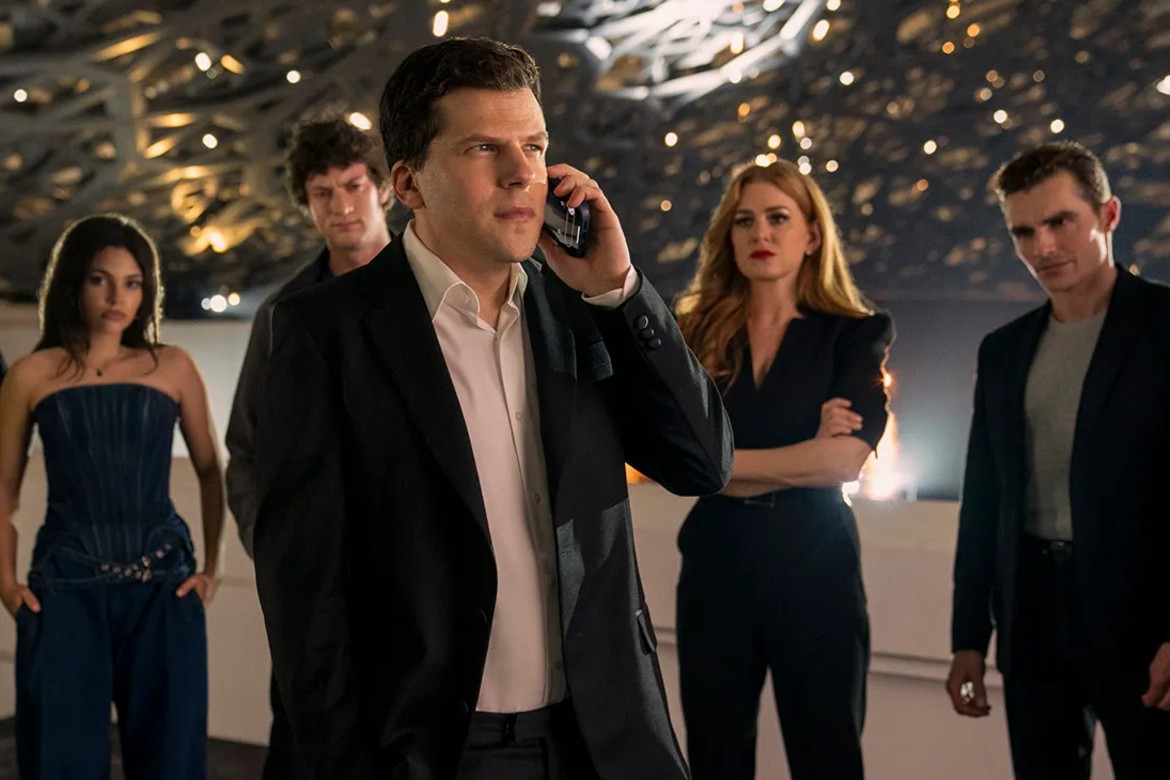
I share the sentiment of my colleague Luiz Santiago in his criticism of Master’s Trick e Master Trick: The 2nd Actin a franchise that has good materials to be a light entertainment and visual spectacle cineseries, but that continues to hit the wrong buttons. After two films that already showed clear signs of exhaustion, the first due to the skid in the third act and the second due to the empty ambition of an inflated mythology, Master’s Trick – The 3rd Act appears as that sequel that tries to fill holes by throwing more paint on the wall. And, as expected, the paint doesn’t dry. The third film maintains all the accumulated vices of the franchise and seems to double down on precisely the elements that most harmed the film. 2nd Act: the artificial idea of the Knights as social vigilantes, a miscalculated sentimentality, a silly moralism and an almost complete drain of what could really make this saga work: the fun of heist and the group’s cheating.
The film insists on dressing its protagonists in the mantle of contemporary Robin Hoods, defenders of global ethics and enlightened warriors against corrupt tycoons, now swelling the cast with a trio of young illusionists who end up stealing space from the charismatic quintet of Jesse Eisenberg, Woody Harrelson, Dave Franco, Isla Fisher and Lizzy Caplan. This bias had already corroded the second film, transforming a proposal that had everything to be fun about trickster magicians performing elaborate tricks for their own benefit into a narrative with delusions of grandeur. Here, the problem worsens. THE 3rd Act it embraces this messianic pretension once and for all, and the little cynicism, selfishness and internal game that made the group interesting in the first feature almost completely disappears. Without competition, vanity and internal trickery, we have uplifting speeches.
The script constantly falls into the exposition trap, a chronic feature of the series, but here taken to an almost comical level. Much of the film consists of characters standing in rooms explaining the trick, explaining the plan, explaining the moral behind the trick, and explaining why it should be impressive. The basic principle of cinema and illusion (albeit in different contexts) of “show, don’t tell” is ignored as if the film was afraid that the viewer would not be able to follow the plot. But this excess of talk does not produce clarity, it produces monotony in the feeling of watching an entire making-of about a trick that was never actually shown.
And this is perhaps the biggest problem with the third feature, without set-pieces remarkable. The franchise, from the beginning, seemed built on the promise of visual spectacle, scenic engineering, tricks that played with perception, rhythm and creativity. Instead, the 3rd Act he preferred to lean towards comedy, towards quick exchanges of dialogue, towards small personality gags, the same type of humor that was already specific in the first film, but which now occupies more than half of the narrative (that whole car block, for example, is horrible).
The few attempts to create great sequences, like the climax in Abu Dhabi, even have a flash of inventiveness, but nothing that comes close to the energy that the franchise seemed to pursue back then. The mansion with illusionary rooms, for example, had the potential to be a perspective trick show, but the film uses it more as a fun corridor of references. There is a lack of technical virtuosity, a lack of inventiveness, a lack of aesthetics. Almost everything seems cheaper, leaner, lazier.
Additionally, there is obvious swelling in the cast. The attempt to introduce a new generation of magicians while maintaining the original cast dilutes the charisma of both groups. The young trio has interesting moments, but not enough to sustain the protagonism that the film insists on giving them. Meanwhile, the original Knights became supporting characters within their own franchise. The film doesn’t seem to know what to do with them, nor how to balance their dynamics with the presence of newcomers.
The result is that no one has any real dramatic space, and the film starts to depend on sentimental dialogues and declarations of loyalty that sound artificial, almost parodic, not to mention the generic villainous presence of a Rosamund Pike completely wasted in the role. This melodramatic accent is particularly uncomfortable. There is a tiring insistence on verbalizing friendship, unity, fraternity, as if the script needed to reinforce an emotion that is not constructed organically. Each scene seems to want to prove that the team is a family, as if it were a Fast & Furious magical – these works need to learn from the trilogy Ocean’s Eleven.
I recognize, however, that the film is not at all unpalatable. There are occasional moments of charisma in the cast and some fun magic, especially in Lula’s block (by far the best humorous presence in the film). Some jokes work, some minor tricks have charm, and the rhythmic structure keeps the film from being completely boring. THE 3rd Act It even passes quickly, but leaves nothing behind: neither spectacle, nor surprise, nor identity.
With all this, the work ends up being the worst type of bad film: one that is forgettable. There is no cinematic disaster, there is no complete fiasco, but there is a flat mediocrity, a lack of impact, a total absence of inventiveness that makes the session irrelevant. It is an automatic product, a tired repetition of already weak ideas, now less energetic and more moralizing than ever. A franchise that promised clever tricks, but ends with speeches and cheap sentimentality. Perhaps the only true illusion here is that a fourth film would make any difference.
Master’s Trick – The 3rd Act (Now You See Me: Now You Don’t) — USA, 2025
Direction: Ruben Fleischer
Road map: Michael Lesslie, Paul Wernick, Rhett Reese, Seth Grahame-Smith
List: Jesse Eisenberg, Woody Harrelson, Dave Franco, Isla Fisher, Justice Smith, Dominic Sessa, Ariana Greenblatt, Lizzy Caplan, Rosamund Pike, Morgan Freeman
Duration: 112 min.

Hi! I’m Renato Lopes, an electric vehicle enthusiast and the creator of this blog dedicated to the future of clean, smart, and sustainable mobility. My mission is to share accurate information, honest reviews, and practical tips about electric cars—from new EV releases and battery innovations to charging solutions and green driving habits. Whether you’re an EV owner, a curious reader, or someone planning to make the switch, this space was made for you.


Post Comment