José Eduardo Belmonte expands borders, films in Detroit and talks about the ‘human adventure’ of cinema

For almost forty years traveling through Brazilian audiovisual, José Eduardo Belmonte He carries with him a restlessness that prevents him from stopping. At 55 years old, the filmmaker born in São José dos Campos and raised in Brasília has just released Almost Deserthis most recent international co-production, filmed in Detroit and which hit theaters on Thursday, the 27th. The film marks a turning point in the trajectory of a director known for embracing different genres — from intimate drama to action blockbuster — and who is now expanding his borders beyond Brazil.
Almost Desert follows two undocumented Latino immigrants and an American woman with a rare syndrome who cross paths in a Detroit devastated by the pandemic. Witnesses to a murder, the three embark on an escape that reveals both urban ruins and human contradictions in times of reconstruction. The film, starring Angela Sarafyan (of Westworld), Vinícius de Oliveira (of Central Brazil) e Daniel Hendler (of The Broken Embrace), was part of the Première Brasil programs at the Rio Festival and the 49th São Paulo International Film Festival.
“Detroit was included in the film because it’s not just a city: it’s a moral landscape,” explains Belmonte. “As it is a city that has gone through several crises, there is a mix of ruin, reinvention and wounded dignity that speaks directly to these dystopian times so lacking in utopias, which is what I wanted to talk about.”
The choice of Detroit as the setting was, therefore, not random. For the director, the process was the opposite of usual. “I didn’t choose Detroit to fit the story,” he says. “After much study of the place, the landscape ended up dictating the rhythm, the light and even the behavior of the characters. It was impossible to film there and make a domesticated film.”
Plural career
With a degree in cinema from the University of Brasília, where his teachers were important figures such as Armando Bulcão and Nelson Pereira dos Santos, Belmonte began his career in the 1990s directing music videos for national bands at the height of MTV Brasil — his most constant partnership was with Raimundos. Since then, he has accumulated more than 30 audiovisual projects including shorts, features and television series.
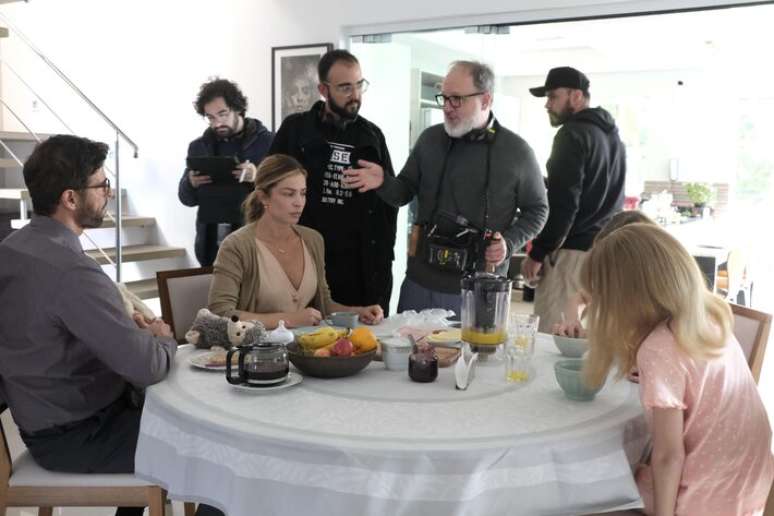
The turning point came in 2008 with If Nothing Else Workswhich toured festivals around the world and won awards at the Rio Festival, Cine Ceará and the Brazilian Film Festival in Paris. Then came works as different as the blockbuster German (2014), which brought a million spectators to cinemas, and series such as Jailerswinner of the MIP Drama Grand Jury Prize in Cannes, and The Hypnotistand HBO.
“Honestly, I believe that, deep down, everything is audiovisual. Cinema has always been this combination of playful impulse with industrial gear”, says the director about his ability to move between such diverse projects. “Within our market, I would say that moving between the independent and the industrial, between the almost artisanal freedom of one and the mandatory precision of the other, is a way of keeping my eye alive. One teaches me discipline, the other reminds me why I started.”
This versatility was showcased in an emblematic way at the last São Paulo Film Festival, where Belmonte presented three films at once: in addition to Almost Desert, Aurora 15 (about a creature he jokes is “more of a lobi-woman guided by the moon”) and Brazilian robbery. “Transiting between such different themes is not dispersion; it is a way of being”, he states. “I know that for some my filmography may seem like a noisy, heterogeneous bar table, full of stories that shouldn’t coexist, but do. It is in this collision that cinema comes alive.”
The observer’s gaze
There is an authorial mark that runs through all of Belmonte’s work: characters out of place, on the margins, in friction with the world. But the director rejects the idea that this is just an aesthetic preference. “These characters are born from a historical circumstance. We live in a country, and an entire continent, built on violence, looting, appropriation, and with an emotional immaturity that permeates everything.”
This vision directly connects with his training in Brasília, a city he describes as full of paradoxes. “Designed as a utopia and lived as a dystopia, full of people from everywhere, but with an architecture that creates an almost permanent feeling of foreignness, even within one’s own country. There, the only really possible position was that of the observer”, he says.
It is precisely this observer’s gaze that Belmonte brings to his films. “Observing, when making cinema, is a form of affection. It is also a form of criticism. And, above all, a way of getting closer to people without turning them into a thesis”, he reflects.
The director’s work process is known for the method called “small suitcase”, a technique in which he investigates the essence of the script to bring more veracity to the story and give freedom to the actors. “The role of a director, for me, is to preserve the essence and it always comes from the characters. They are the ones who determine the way of doing things”, he explains.
But the tone of his films is not something rigidly planned. In Almost Desertfor example, a production accident — actress Angela Sarafyan injured her foot on the day of filming the first action sequence — ended up shaping the film’s aesthetic. “So, instead of opening as an ‘American action film’, I realized that the radical gesture was to let the deconstruction begin right there, before the viewer realizes that there was something to deconstruct. An escape that happens slowly, full of gaps and in silence”, he says. “This type of accident does not compromise the tone; it reveals it. Therefore, tone is not constructed, it is conquered, like a territory.”
The project of Almost Desert It was born from a personal provocation. “It all started when a friend who went to live abroad came back full of questions about what it means to be Brazilian and Latin, and that sparked a path for me,” he says. The question was added to a concern that arose during the filming of My World in Danger. “How far could my way of filming – fast, objective, collective and open to contributions from the cast – go beyond our borders?”, he asks.
The answer came in 2014, when he directed a series for HBO in Uruguay with actors of different nationalities. According to him, that human mixture dismantled any idea of cinema as a closed territory. Filming with people from such different places, hearing the echoes of the same work resonating in several countries in Latin America, in the Latin community in the United States, reorganized his way of thinking about directing.
Filming outside Brazil, therefore, becomes a destabilizing but productive experience. “Filming abroad, you quickly understand that nothing is given: logistics, crew, rhythm, even the way people read a scene changes. It’s destabilizing, but in a productive way. Your mind expands when you can’t reproduce the ‘culture’ at home,” he says.
Belmonte makes it clear, however, that internationalization does not mean abandonment. “Festivals, co-productions, markets, all of this matters, as long as it doesn’t turn the film into just a product to satisfy a ‘universal’ fantasy”, he highlights. “I’m moving towards this, but little by little, the idea is that it makes sense for the films I want to make, not to fulfill a career checklist.”
New projects and dreams
The filmmaker is currently filming Justinanother international co-production. On the table, there is also a horror feature in Brazil, another international project already underway and the adaptations of two books by Ignácio Loyola Brandão, projects that have been with him since college.
Regarding the current situation in Brazilian cinema, Belmonte is a realist. “Jabor said that Brazilian cinema was an eternal Lazarus, always resurrecting. After almost 40 years in it – I started directing at 22 -, I can confirm that the phrase doesn’t get old”, he says. “We need to reinvent production, circulation and, above all, abandon certain fetishes, including those that divide our cinematic community.”
And it is with this awareness that he moves forward, always on the move. “I learned early on not to fall into that trap and to preserve the human experience of work,” he says. “And what excites me most today is everything that still scares me. That’s how I keep my eyes and cinema alive, not so much as a showcase and more as a human adventure.”

Hi! I’m Renato Lopes, an electric vehicle enthusiast and the creator of this blog dedicated to the future of clean, smart, and sustainable mobility. My mission is to share accurate information, honest reviews, and practical tips about electric cars—from new EV releases and battery innovations to charging solutions and green driving habits. Whether you’re an EV owner, a curious reader, or someone planning to make the switch, this space was made for you.



Post Comment