“A House of Dynamite”: The Netflix nuclear attack in reality check
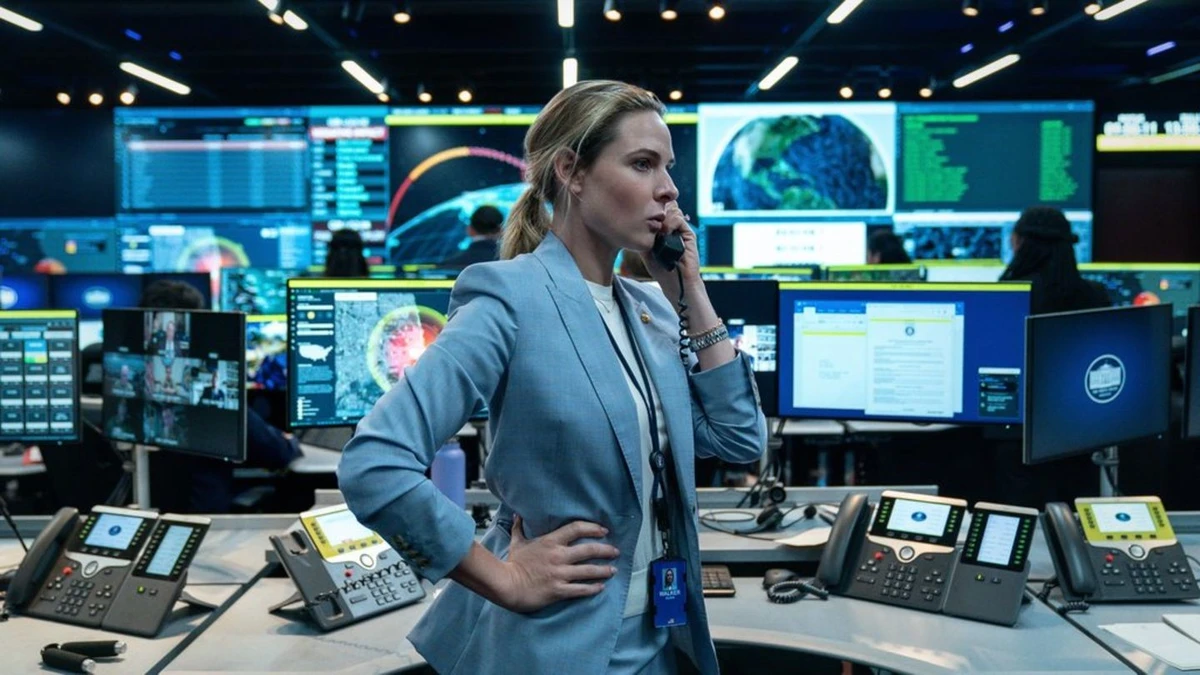
If a nuclear attack is registered, a clear protocol applies.Image: Netflix
Analyse
In “A House of Dynamite” there are 19 minutes left until the nuclear strike. The Netflix film is fictional and yet shows the reality of a system that is dangerously fragile. A look behind the scenes of the misleading nuclear weapons security architecture.
24.10.2025, 18:4724.10.2025, 18:47
In the new Netflix film “A House of Dynamite” the seemingly last minutes before a nuclear war are running: A missile is on its way to Chicago, shortly afterwards it is identified as a nuclear weapon. Nobody knows for sure who fired it.
In the film, director Kathryn Bigelow shows a dilemma that no longer seems so far-fetched given the current fragile geopolitical world situation: an attack with a nuclear missile and the mechanisms that then come into force. “A House of Dynamite” examines the time from the alarm to the impact from the perspective of various actors. A scenario that no one wants.
The film gives an idea of how fragile the system is, which derives security from the threat of mutual destruction.
When you hear such an alarm, do you resort to retaliation – and thereby fuel a deadly spiral? And what happens if there is a nuclear attack on Europe? How realistic is the scenario in the film? One thing is certain: the fate of millions lies in the hands of a few people, their mood, whereabouts and sometimes random eventualities.
“A House of Dynamite” paints a scenario that no one wants to experience.Image: Netflix
Netflix film shows nuclear attack: a few minutes until impact
Half an hour at most, that’s all there is to it. That’s how long an intercontinental ballistic missile would need to fly from Russia or North Korea to the USA, explains former US officer John Warnock in the military magazine “Warrior Maven”. Thirty minutes maximum to determine whether it is a false alarm, determine the source, and decide how to respond.
“Launch on warning” is the name of the principle behind the deterrent tactic: shoot back before your own ground is hit. This formula already contains the contradiction of the nuclear dilemma: it wants to create stability by being ready for escalation at any time.
The smallest mistake can become a trigger – a technical malfunction, a misjudgment, an impulsive command.
In the film, Bigelow condenses this reality into three levels of action: in the control room, in the Department of Defense and in the Oval Office. In this way, it reflects real chains of power – and shows communication channels that can break down in an emergency while seconds count.
Moscow: A Russian nuclear missile passes through Red Square during the Victory Day parade.Bild: epa / Yuri Kochetkov
The fact that her portrayal appears so authentic is also due to the sources her team was able to use. Screenwriter Noah Oppenheim said, according to “Gold Derby”:
“We were able to talk to people at the highest levels in the White House and the CIA. They were willing to talk to us because they trust that a Kathryn Bigelow film will treat them with respect and realistically portray their world.”
This reality also includes: In the USA, only the president can give the order to launch a counterattack. There are no checks and balances that can stop an impulsive decision in real time.
Intuition instead of protocol: Fragile system surrounding nuclear war
As early as 1983, only the intuition of a Soviet officer prevented a nuclear counterattack: Stanislav Petrov suspected in the early warning center that the reported US missiles could be a mistake – and did not report the alleged attack. His decision, contrary to protocol, may have saved millions of lives.
Europe relies on a system of warning chains, radar signals and decision-making bodies – and on the assumption that they will hold up in an emergency. The centerpiece lies at the Ramstein air base: There the Allied Air Command controls NATO’s air and missile defense. Integrated Air and Missile Defense (IAMD) monitors the skies over Europe around the clock and analyzes threats in real time.
Ramstein: The NATO representatives’ meetings take place here.Image: dpa / Uwe Anspach
But this system could be overwhelmed in a coordinated attack. Hypersonic missiles like those used by Russia fly at over five times the speed of sound and change their trajectory as they approach, making it almost impossible to intercept them. This shortens the already short decision-making time.
Since Donald Trump’s return to the White House, Europe has been talking more openly about its own nuclear deterrent. “The Europeans have to deal with the possibility that America’s protective shield could disappear,” said security expert Jan Techau on Deutschlandfunk (Dlf).
Great Britain and France are the only European countries with their own, comparatively few, nuclear weapons. They want to coordinate their deterrence and “respond together to any extreme threat to Europe.” A symbolic but significant step because France has so far rejected any operational coordination.
Nuclear weapons in Europe: German participation and the illusion of control
But what happens if the scenario from Bigelow’s film took place in Europe – for example in Berlin? Twenty to thirty minutes remained between the alarm and the impact. Within this time, a decision would have to be made as to whether the attack was real and whether one would risk the counterattack that would seal everything.
In case of doubt, it is not the alliance as a whole that decides, but rather individual heads of state and government. The US retains control of its warheads; France and Great Britain have their own systems. NATO emphasizes that all nuclear planning remains “under political control,” but in an emergency the command would lie with the respective governments.
Germany is participating in so-called nuclear sharing: US atomic bombs are stored on German soil, and German jets are carriers in an emergency. Some experts say that is no longer enough. Political scientist Frank Sauer advocates for a German deterrent potential at the DLF: Only those who can threaten themselves are credible.
Berlin: Protest action by activists against nuclear armament.Image: imago stock&people / Reiner Zensen
Others warn of a dangerous illusion.
Juliane Hauschulz from the International Campaign to Abolish Nuclear Weapons (ICAN) emphasizes that nuclear weapons “could never bring security.” Even a limited operation would quickly escalate into a global conflict. A counterattack would hardly be justifiable under international law: the principle of proportionality would remain unfulfillable. Hauschulz speaks of a “dangerous normalization” of the discussion, as if nuclear weapons could be controlled.
The structural problem remains: Europe talks about strategic autonomy, but largely operates under an American command structure. There is currently no real European deterrent. Construction would take years, both politically and technically.
This is the blind spot of modern security policy: While arms technology is organized collectively, decision-making power remains concentrated.
Deterrence only works as long as no one stumbles
Bigelow’s film is fiction, but its logic corresponds to reality: false alarms, communication errors, unclear orders – all of it can happen.
And yet the principle holds: Deterrence is intended to prevent war by remaining credible at all times. “The balance of terror” remains a rhetorical cover for a system based on minute decisions, signal fidelity and human self-control.
There is a growing realization in Europe that nuclear security cannot be planned, but rather managed at best. NATO exercises like Steadfast Noon regularly simulate crises with a nuclear dimension. But in the end everything depends on people, not systems.
Bigelow herself calls her film a “cautionary tale.” She hopes that it will initiate a discussion about reducing nuclear weapons stocks – in a world in which nuclear sharing and first strike capability are being discussed openly again.
Bigelow’s warning aims precisely at this contradiction: the apparent security structure provided by nuclear weapons is a permanent state of moral emergency. The nuclear order remains stable not through strength, but through the luck that no one stumbles.

Hi! I’m Renato Lopes, an electric vehicle enthusiast and the creator of this blog dedicated to the future of clean, smart, and sustainable mobility. My mission is to share accurate information, honest reviews, and practical tips about electric cars—from new EV releases and battery innovations to charging solutions and green driving habits. Whether you’re an EV owner, a curious reader, or someone planning to make the switch, this space was made for you.




Post Comment