Best films: Joachim Trier’s Sentimental Value wins the year
The most elating scene I saw this year was in QueerLuca Guadagnino’s shimmering adaptation of William S. Burroughs’ novella. Daniel Craig, playing Burroughs’ alter ego, is setting up to shoot heroin. Craig perfectly captures a junkie’s taut eagerness for the anticipated high. The rush is scored to “Leave Me Alone”, a persuasive post-punk lament from New Order’s 1983’s album, Power, Corruption & Lies.
Ostensibly set in the 1950s, the bars and streets we see of Mexico City in Queer are clearly studio sets. The hallucinogen palette of the film is itself a commentary on the history of expat avant-garde artists using the colonial peripheries as playgrounds for their fantasias. The New Order needle-drop underscores Guadagnino’s intelligence.
Though much of the initial novella was written in the mid century, the novel wasn’t published until 1985. This riveting scene of narcotic dissipation reminds us of a history of censorship and homophobia and why Guadagnino is one of the best of current directors and Craig one of the best of present-day actors.
Intelligence and precision also mark After the Hunt, Guadagnino’s other film from this year. He takes as a provocation a premise that already seems exhausted, the extremities and challenges of contemporary campus radicalism. Instead of making a film about the “issues”, he deploys the aesthetic strategies of 1960s European arthouse cinema to deliver a chilling, dispassionate study of modern haute-bourgeois alienation.
Julia Roberts, Ayo Edebiri, Andrew Garfield, Michael Stuhlbarg and Chloë Sevigny form a superb ensemble cast. None of them signal to the audience. Like the director, they’re not interested in telling you what to think.
One film that can’t stop yelling at you is Paul Thomas Anderson’s One Battle After Anotherthe year’s most wildly overrated film. In fairness, it does have a climactic scene that is one of the greatest car chases I have ever seen. The chase, a dizzying call and response between director and editor, is euphoric: pure cinema. But the film runs for three hours and the rest of it bored me shitless. The script is adolescent paranoia dressed up as cutting-edge social commentary and, like most sophomoric thinking, there’s a huge dollop of mawkishness and masochism amid all the faux-revolutionary rage.
A much finer and much more elegant mediation on the connections between the 1960s counterculture and our contemporary politics from this year was Paul Schrader’s Oh, Canada – a film imbued with wisdom and regret.
Mike Leigh’s Hard Truths was also wise. Leigh makes an unlikeable character the centre of his film. Its economy of pace and design made me wish more directors would take note of Leigh’s unobtrusive, candid style. The actors, who include Marianne Jean-Baptiste, Michele Austin and David Webber, are all outstanding.
James Sweeney’s Twinless was a gem – smart, complex and always surprising. Óliver Laxe’s Cry is an adrenaline hit. The fusion of techno and heavy metal, both as sonics and as a guiding stylistic choice, is compelling. And it is genuinely shocking.
Danny Boyle’s 28 Years Later is elegiac. Allegory has always been part of the zombie genre, but by making us see the apocalypse through the eyes of a 12-year-old child, Boyle and scriptwriter Alex Garland lend an element of fable and wonder to the narrative. This is a striking film and the score by Young Fathers was propulsive, frightening.
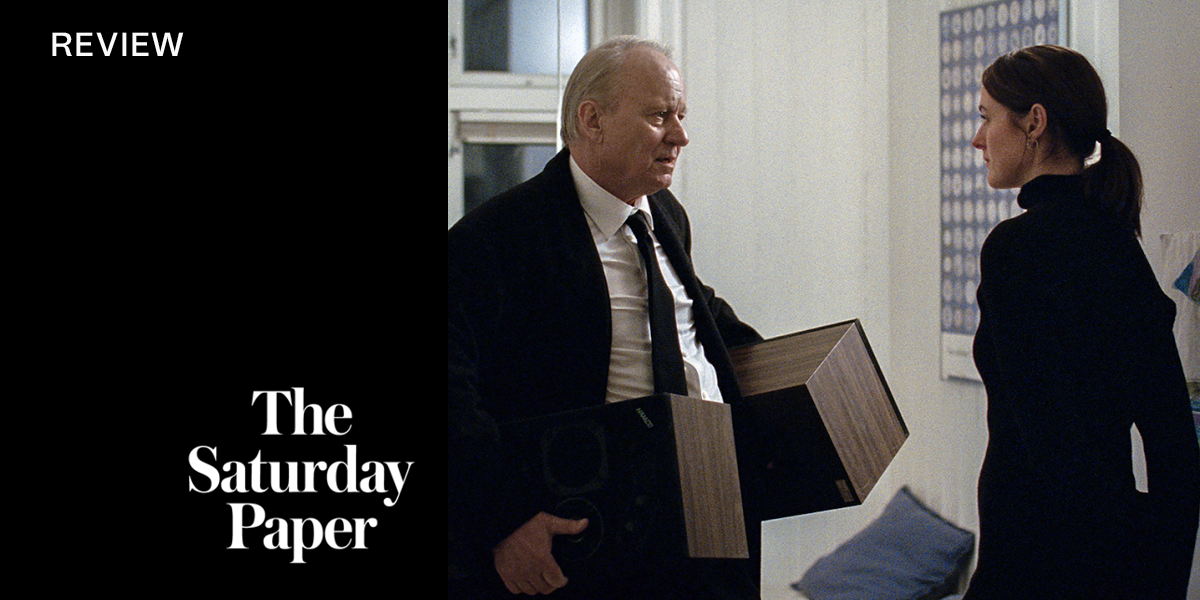
The best film of the year is Joachim Trier’s Sentimental Value. He has achieved a stunning control as a director. The cast and crew work in such precise unison that the final result has a musical glory. The effect is exultant, like watching the work of a supremo conductor.
The film is about the legacies of art, centred on the relationship between a film director (Stellan Skarsgård) and his actor daughter, played by Renate Reinsve. Unavoidably, the central conflict and the Scandinavian setting recall Ingmar Bergman’s Autumn Sonata (1978), but Sentimental Value is more disciplined and more truthful, more gracefully felt and directed.
The acting is joyously good: you can sense the pleasure they are taking in playing characters of real complexity and prickliness. Another film for an audience that doesn’t need to be told what to think.
This article was first published in the print edition of The Saturday Paper on
December 20, 2025 as “The year in reviews”.
For almost a decade, The Saturday Paper has published Australia’s leading writers and thinkers.
We have pursued stories that are ignored elsewhere, covering them with sensitivity and depth.
We have done this on refugee policy, on government integrity, on robo-debt, on aged care,
on climate change, on the pandemic.
All our journalism is fiercely independent. It relies on the support of readers.
By subscribing to The Saturday Paperyou are ensuring that we can continue to produce essential,
issue-defining coverage, to dig out stories that take time, to doggedly hold to account
politicians and the political class.
There are very few titles that have the freedom and the space to produce journalism like this.
In a country with a concentration of media ownership unlike anything else in the world,
it is vitally important. Your subscription helps make it possible.

Hi! I’m Renato Lopes, an electric vehicle enthusiast and the creator of this blog dedicated to the future of clean, smart, and sustainable mobility. My mission is to share accurate information, honest reviews, and practical tips about electric cars—from new EV releases and battery innovations to charging solutions and green driving habits. Whether you’re an EV owner, a curious reader, or someone planning to make the switch, this space was made for you.


Post Comment