Between the police and traffic, residents are left with rubble
It was Tuesday and the sun hadn’t yet risen when Jéssica Pereira, 36, woke up with a start, before the alarm clock went off. His routine, which starts at six in the morning, was interrupted by the intense noise of gunshots in the community. Quickly, the shrill sound of bullets crossing the street intensified, causing her and her family to run to another room of the house in search of protection. When they were hiding in the bathroom, Jéssica heard a conversation outside the property being interrupted by screams repeating the same phrase. “He got shot! He got shot!”
Fear turned to anguish as the men jumped into the yard. Jessica knew it was a matter of time before they entered her house for shelter. It didn’t take long for the door to open brutally. When looking into the living room, the resident saw around ten police officers entering the house to help one of them who had been shot minutes before.
The injured man was Bernardo Leal, assistant delegate of the Civil Police of Rio de Janeiro. He was taking part in the mega-operation against the Comando Vermelho (CV) faction, carried out in the Penha and Alemão complexes, last Tuesday (28). Three days after the confrontation, which resulted in more than 120 deaths and became the deadliest operation in the country’s history, Bernardo remains hospitalized in serious condition and had to have a leg amputated.
Why does this matter?
- Considered “a success” by the governor of Rio Cláudio Castro, Operation Containment resulted in 121 deaths and countless losses to the residents of Complexo da Penha.
- Demonstrations took place in several cities across the country against the operation of the Rio de Janeiro government, including in Rio de Janeiro and São Paulo.
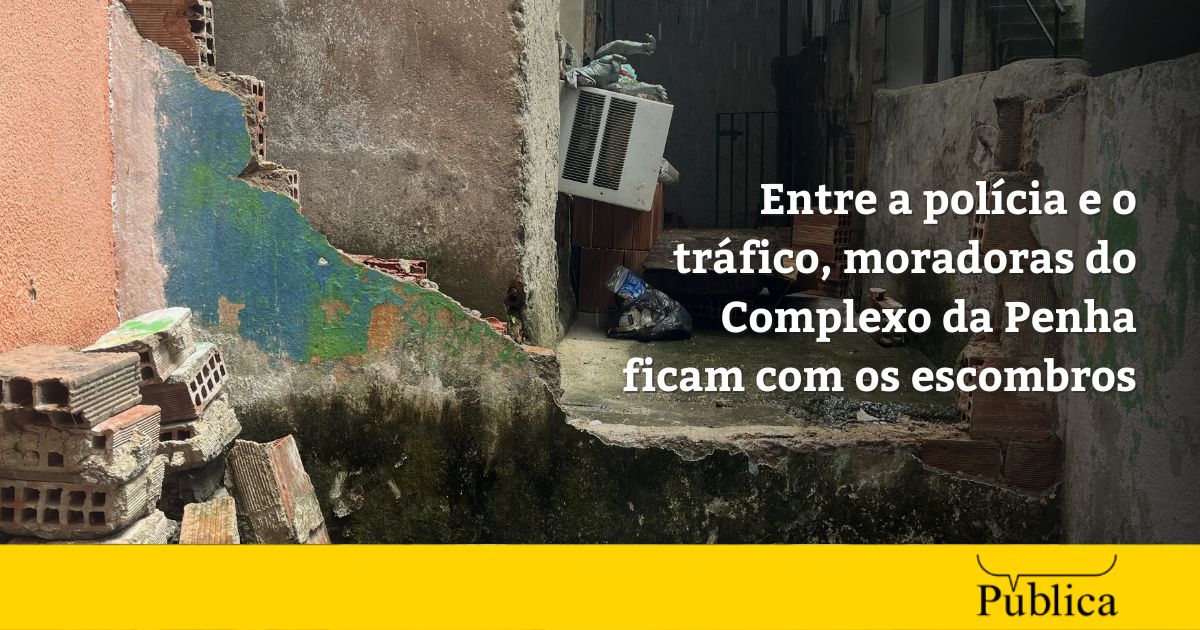
“Unfortunately we are going to have to stay here. It was the only place we found to take refuge”, said one of the police officers. While the shots continued incessantly outside the house, the group tried to contain the deputy’s wound, so that he wouldn’t lose even more blood. In the search for rescue and emergency medical care, the police warned that they would break the kitchen wall to carry Bernardo to the back of the house. “It’s not right, but we’re going to have to break to save it”said one of the men. With no suitable tool in sight, a gas canister was thrown to break through the wall.
With the incessant crying of her youngest daughter, 12 years old, Jéssica begged to leave the property. “You can’t leave, no. If you leave, you’ll die. Calm down, we’ll protect you. Everything will be fine”, recalls Jéssica, reproducing the dialogue with one of the police officers, while placing her hand on her stomach. She says that at that moment she even forgot about the pregnancy, discovered four days earlier. Since the mega-operation, Jéssica has been losing blood and is awaiting a test to find out if the baby is alive.
Born and raised on the same street, Jéssica is a single mother of two teenagers and works in a chocolate factory. She lives in the house that was invaded by security agents just over a year ago with her children and her father. They moved after Jéssica’s mother died in her arms, the victim of a heart attack. She recalls the countless police operations she has seen take place in the region, but nothing as intense as this one.
An evangelical, it was in the church that she found the strength to deal with the harshness of life. Even though he doesn’t know how to deal with the recent material and psychological damage, he says he doesn’t feel angry with either side in the war. “I don’t think ‘ah, they’re criminals, they chose this life because they wanted to’ and the same thing with police officers. What is lost is the soul, and we want life, we don’t want death”, he states.
Home is invaded by dozens of men
That morning, on the same street, a few meters away, a group of around 30 men asked Suelen Gonçalves, who is also 36 years old, to open the Bible and say prayers. They had broken into her home while she and her family hid in one of the bedrooms to protect themselves from the intense gunfire outside.

Amid the shots of tracer rifle ammunition that hit the neighborhood, Suelen’s husband heard a noise in the next room. When he went out to see what was happening, he found dozens of men entering the house to escape the police. On the top floor and on the roof of the house, it was possible to see the movement of fugitives carrying rifles and carrying backpacks filled with money and ammunition.
One of them left blood marks wherever he went, as he had been shot during the operation. Suelen doesn’t know exactly how long the men stayed in her house, but she remembers hiding her 12-year-old son under one of the beds. He also doesn’t forget that the Bible in the room where he was protected was often used by drug traffickers.

The most striking memory of that endless morning, however, was the group’s surrender after the police arrived at the scene. “They let my aunt, my husband and my son leave. When I was about to leave, they said ‘no, auntie, not you. You’re going to stay or they’re going to kill us’. At that moment I thought I was going to die.”vent.
One of the traffickers’ requests was for Suelen to record their surrender. With her own cell phone, she films the moment they surrender, while she is held hostage by the last man. Everyone goes down the stairs of the property together, towards the first floor. Upon arriving in the living room, Suelen sees one of the men dead from a gunshot he received in the confrontation before invading the property.
After the invaders left, a group of police officers entered the house to collect all the belongings left there. Suelen accompanied the agents who, according to her, searched the house looking for other weapons, drugs and money. At all times, she pointed out to the police what belonged to the drug dealers and what belonged to her.
Suelen reports that she was happy, before those events, to have just renovated the living room. The family leads a simple life, as the income comes from the food she prepares with her mother in a guesthouse, and from her husband’s salary, who is a doorman at an Emergency Care Unit (UPA) in the neighborhood. After the operation, neighbors helped clean the house and throw away the sofa and a set of chairs.
She reveals that one of the few luxuries she has is paying for training in different sports for her son, who practices jiu-jitsu and takes classes at Flamengo’s football school. “His dream is to be a player. He says he wants to become a professional to get us out of here”, he says. After what happened last Tuesday, Suelen’s son is temporarily living with his grandmother because he is unable to return home.
Anger was also not a feeling shared by Suelen. Even though she is not religious, she said that it was Psalm 91 that helped her to remain calm throughout the operation. “He who dwells in the secret place of the Most High, in the shadow of the Almighty, will rest. A thousand will fall at your side, ten thousand at your right hand, and you will not be struck.”
The day after the shooting, the Penha resident received an unexpected visitor. The mother of the man who held her hostage during the group’s departure came to thank her for her strength and wisdom. “She was the only person who hugged me after what happened. At that point, I broke down and started crying”, he recalls.
Residents demonstrate against violence

This Friday, October 31st, at the bottom of the hill, hundreds of people gathered for a peaceful demonstration against the most lethal police operation in the country’s history. The Penha complex court, which is usually a space to celebrate festive moments, brought together residents, people from outside the community, as well as the press.
The act, carried out to protest the deaths that occurred days before, could not include all the family and friends of the dead. Many still sought recognition of the bodies at the Legal Medical Institute (IML).
Inside the crowd, a mother followed the group, shyly and trying to smile. Resident of the Complex, Monique Jesus claims she lost her 15-year-old son three weeks ago. She does not deny that her son was involved, but defends the right to mourn. “When I saw the images of the bodies lined up in the square, I felt like crap.”
Amidst songs and slogans, a protester asks: “Is the crime over? Is it over? Is the crime over? I want you to answer! After everything they did, is the crime over?”
“I think this is absurd, that they can go in and kill. They say ‘ah, criminals kill’, but they also kill! What’s the difference between a criminal and a police officer? Is it because they wear a uniform?”, he asks the camera.
Some participants also criticized the governor of Rio de Janeiro, Cláudio Castro. For professor Júlio César Soares, who also participated in the demonstration, “the governor did not take responsibility for (applying) public policies for these communities”. “A lot of unemployment here, a lot of lack of health and (of) education. And he only comes with the police, just to kill”these.
Rute Sales, from the Black Women’s Movement and the “Stop Killing Us” Movement, assesses that Castro “has no political responsibility towards human beings”. “It is not possible for a governor to have the license to reach communities and promote barbarism, this slaughter of more than 100 people”, adds Sales. “Have we already approved the death penalty? Or does the death penalty already exist in the governor’s mind?”he concluded. At the end of the same day, a demonstration also took place in the city of São Paulo, against the mega-operation in Rio de Janeiro.
According to data from the State government and the Civil Police, Operation Containment was motivated to control the expansion of the CV and execute arrest and search and seizure warrants. During the action, 121 people were killed, including four police officers, 113 were arrested and nine were injured, three residents and six police officers.

On the afternoon of Friday, October 31, the Rio government released the names of 99 of the victims of the massacre, according to Valor Econômico. At a press conference, the secretary of the Civil Police of Rio de Janeiro, Felipe Curi, stated that among those identified, 78 had a “relevant criminal history”. The name of none of them, however, appeared in the complaint from the State Public Ministry that supported the Megaoperation and was presented in May this year, according to a report by Uol.

Hi! I’m Renato Lopes, an electric vehicle enthusiast and the creator of this blog dedicated to the future of clean, smart, and sustainable mobility. My mission is to share accurate information, honest reviews, and practical tips about electric cars—from new EV releases and battery innovations to charging solutions and green driving habits. Whether you’re an EV owner, a curious reader, or someone planning to make the switch, this space was made for you.



Post Comment