Herzog case: act at the Cathedral requests pardon from the State and protest against amnesty for Bolsonaro
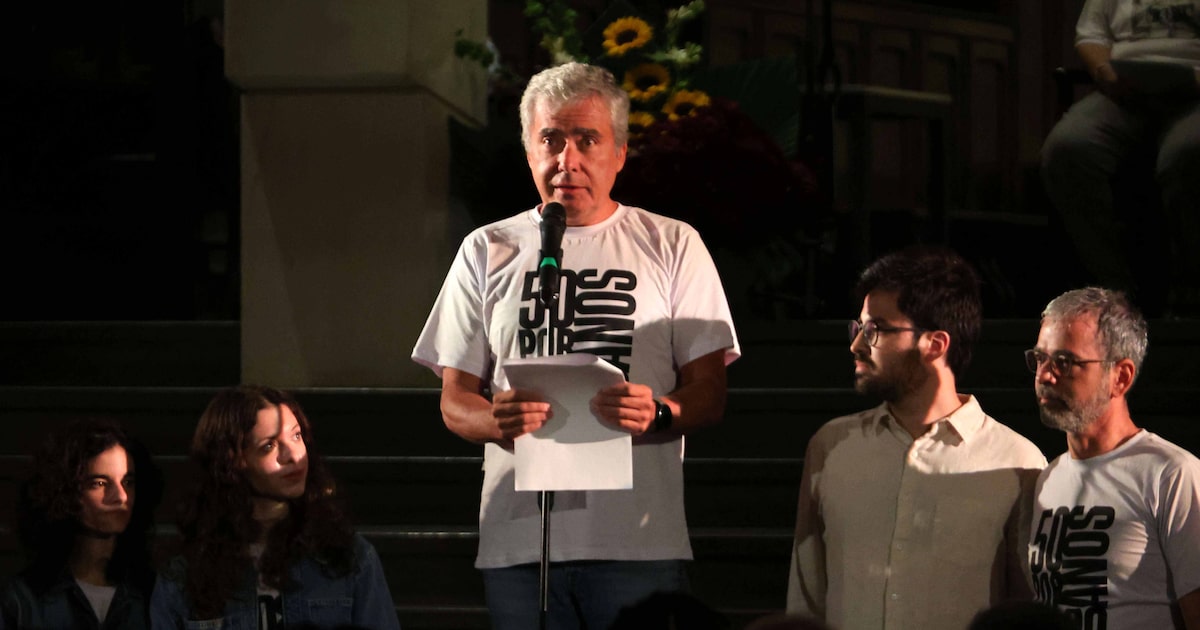
Fifty years after the journalist’s death Vladimir Herzoghis murder on the premises of the Information Operations Detachment (DOI), of the 2nd Army, was remembered with an inter-religious act “against violence and for peace” in the Sé Cathedral. For the first time a sitting President of the Republic – Geraldo Alckmin – was present at the celebration, as well as the president of the Superior Military Court (STM), minister Maria Elizabeth Guimarães Teixeira Rocha.
The minister asked for forgiveness: “Forgiveness to all who fell and suffered fighting for freedom in Brazil. Forgiveness for the judicial errors and omissions committed during the dictatorship. I ask forgiveness from Vladimir Herzog and his family, Paulo Ribeiro Bastos and his family, Rubens Paiva and Miriam Leitão and their children, José Dirceu, Aldo Arantes, and José Genoino, Paulo Vannuchi, João Vicente Goulart and so many other men and women who suffered from torture, deaths, forced disappearances and exile”.

Interreligious event held on Saturday night, October 25, 2025, at the Sé Cathedral, central region of São Paulo, brought together religious leaders, family members and social movements in honor of Vladimir Herzog and all the victims of the military dictatorship Photo: Fábio Vieira/Estadão
The minister was interrupted by applause and shouts “no amnesty”. And he continued: “I finally ask for forgiveness from Brazilian society and the country’s history for the judicial errors committed by the federal Military Justice to the detriment of democracy and in favor of the authoritarian regime.”
Then it was Alckmin’s turn to speak, almost at the end of the celebration. “Not even the most cowardly of lies, forged by the most vile of tyrannies, was able to erase the brutal truth that had befallen the country. Just as in the defense of the truth, there was no place for the farce of suicide, in the same way, for the love of freedom, there will never be a place for us to be forgotten,” said the acting president.
Alckmin continued, stating: “The memory of Vladimir Herzog remains alive and evokes in each of us the promise to defend the sacred values of life, freedom and human rights. Therefore, I reaffirm here, on behalf of President Lula and myself, our promise, and much more than promise, our unshakable commitment and persevering commitment to the defense of truth, justice and democracy. Long live the alliance of faith, religions, human dignity.”
Upon arrival at the church, the speeches of the most important authorities present showed the impact of the act. “Vladimir Herzog’s death was the result of the extremism of the State which, instead of protecting citizens, persecuted and killed them. Hence, the importance of strengthening Justice, democracy and freedoms”, stated Alckmin.
The STM minister also spoke upon arrival. “This act today means that we are here to honor the memory of Vladimir Herzog, that we cannot allow the dictatorship to return because unfortunately authoritarianism haunts us, even when we imagined that the dictatorship was already consolidated in the country”, he said.

Interreligious event held on Saturday night, October 25, 2025, at the Sé Cathedral, central region of São Paulo, brought together religious leaders, family members and social movements in honor of Vladimir Herzog and all the victims of the military dictatorship Photo: Fábio Vieira/Estadão
It was 7:05 pm when a choir crossed the crowded cathedral, where a crowd, welcomed with white flowers at the entrance, gathered inside. He stood on the side of the cathedral to begin the celebration 20 minutes later. Sang to Creole Missaby Argentine composer Ariel Ramirez, which paid homage to two German nuns, Elisabeth and Regina Brückner, who secretly brought food to prisoners in a Nazi concentration camp.
Amidst the choir singing, a video showed the names of those killed by the military dictatorship (1964-1985). A minute of silence followed in memory of Vlado and all those killed and disappeared from the period caused by State violence to the present day. The silence was then broken by the chords of the song The Drunkard and the Treadmillby João Bosco and Aldir Blanc, performed by Cida Moreira and the choir.
Promoted by the Vladimir Herzog Institute and the Arns Commission, the event brought the Cardinal Archbishop of São Paulo, d. Odilo Scherer, Rabbi Uri Alam, from Congregação Israelita Beth-El, and Pastor Anita Wright, daughter of one of the religious who participated 50 years ago in the original ecumenical act, Pastor Jaime Wright. The first to speak was Cardinal Scherer.

Ecumenical act in honor of Vladimir Herzog, in the Sé cathedral Photo: Marcelo Godoy / Estadão
“50 years ago, a crowd gathered in this same church that was appalled and called for respect, freedom and democracy due to the death of Herzog, brutally tortured and murdered by the military regime due to his fight for democratic freedoms and human rights”, stated the cardinal in his speech to those present, before the national anthem filled the main nave of the cathedral with its chords.
A d. Odilo had the difficult task of shepherding the spirits of those present, a task that was in the hands of the eloquent d. Paulo Evaristo Arns, the charismatic Franciscan who led the celebration that October 1975. “If we are here without fear, it is because we owe it to people who paid a high price, often with their lives. We are here so that social coexistence is free from all types of violence, intolerance and injustice”, he concluded.
After the cardinal’s voice, the rabbi’s message resounded throughout the room. Fifty years ago, Henri Sobel had been there, with his unmistakable diction, to witness the violence that had befallen Herzog. “I dedicate my speech to the elevation of the souls of Vladimir Herzog, Cardinal Arns, Rabbi Sobel and Pastor Wright and to the memory of all who were murdered during the dictatorship” stated Alam.
For the pastor, Herzog’s death was the turning point, the beginning of the end of the dictatorship in the country. “We gather here to affirm that we have learned from the past. Every human being is created in the image of God. Torturing and killing diminished the presence of God. When the state tortures and kills, the victims and the belief in Justice die. Remembering is resisting. Resisting is living.” The rabbi prayed in Hebrew and concluded. “We are grateful for being alive, for having resisted.”

The cardinal-archbishop d. Odilo Scherer and pastor Anita Wright (seated) Photo: Fábio Vieira/Estadão
Finally, it was Anita’s turn. Her father, Pastor Wright, was not there by chance in 1975. Her brother – and Anita’s uncle – was the former deputy Paulo Stuart Wright, leader of Ação Popular, from the Catholic left that opposed the regime and was banned by the dictatorship.
Paulo had been kidnapped in 1973 by men from the same DOI of the 2nd Army, who two years later would kill Herzog. And disappeared in the middle of the night and fogat night and in the fog of those years.
“We are gathered here to celebrate the memory of Vladimir Herzog and all the victims of the military dictatorship”, said the pastor. She remembered the death and disappearance of her uncle. And the struggle of other family members of victims of the dictatorship. “We are here to recognize the importance of an ecumenical act carried out 50 years ago in the process of resuming democracy.”
She added: “The military dictatorship made us walk through the valley of the shadow of death, but the security of having God our shepherd at our side gave us courage, guiding and comforting us with his rod and his staff. 50 years ago, God prepared a table in this same place for more than 8 thousand people in the presence of the enemy who surrounded Praça da Sé.”

An interreligious event held on Saturday night, October 25, 2025, at the Sé Cathedral, in the central region of São Paulo, brought together religious leaders, family members and social movements in honor of Vladimir Herzog and all the victims of the military dictatorship. Photo: Fábio Vieira/Estadão Photo: Fábio Vieira/Estadão
Afterwards, the people who participated in the event 50 years ago were honored and who this Saturday also attended the cathedral while the crowd present shouted “no amnesty” before a video with the speech of journalist Audálio Dantas, then president of the Journalists Union, was shown. And retired federal judge Márcio José de Moraes was applauded, who, in 1978, condemned the Union for the journalist’s death.
Afterwards, in a video, actress Fernanda Montenegro read the letter written by Zora Herzog, Vlado’s mother, to judge Moraes. “My son will not return, but his good name will not be tarnished. If his disappearance was not in vain in the history of the country, for me his loss is definitive, my pain has no consolation.”
The policing scheme in Praça da Sé was there to protect the authorities and the people who went to the ecumenical event, in contrast to the 172 agents from the Department of Political and Social Order (Dops) who were there 50 years ago to monitor, control, record and arrest, if necessary, the participants in the celebration at the time, which was attended by the cardinal archbishop d. Paulo Evaristo Arns, Pastor Wright and Rabbi Sobel.
Other speeches followed until it was the turn of Ivo Herzog, the journalist’s son, who was nine years old when his father was murdered. Ivo thanked Alckmin for his presence, with all the symbolism it carried, and for the fact that the acting president was there. By his side was André Herzog, his brother. “Long live peace, long live Justice, long live freedom, long live Vladimir Herzog, long live Brazilian democracy”, he concluded.
In the end, the act became a protest against the amnesty. That was when the former Minister of Justice José Carlos Dias, for the Arns commission, spoke out: “Today we live under the threat of amnesty. Thank God, we are still alive. Human rights cannot be violated.”
Until Minister Elizabeth took the floor with her request for forgiveness. She was applauded. The last speech that day was also the most anticipated: that of acting president Alckmin, a symbol that the Brazilian State dissociated itself from the crime committed in its name in the past. “Long live all those who fought for our freedom. Long live Herzog! Long live democracy! Long live Brazil!”, stated Alckmin. The event ended at 9:40 pm.

Hi! I’m Renato Lopes, an electric vehicle enthusiast and the creator of this blog dedicated to the future of clean, smart, and sustainable mobility. My mission is to share accurate information, honest reviews, and practical tips about electric cars—from new EV releases and battery innovations to charging solutions and green driving habits. Whether you’re an EV owner, a curious reader, or someone planning to make the switch, this space was made for you.


Post Comment