Judith Collel presents ‘Frontera’ at Seminci
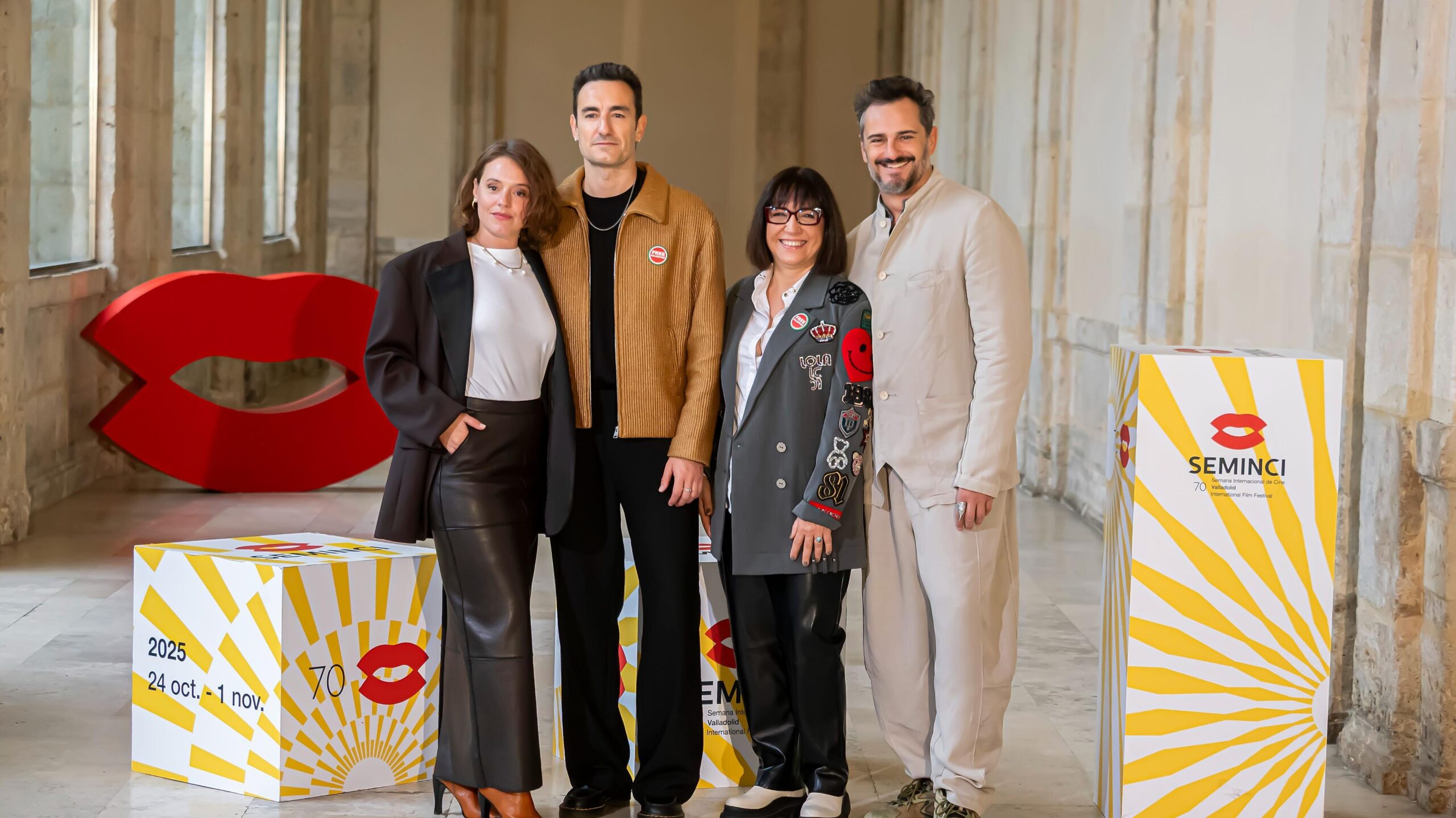
Fronterathe new movie Judith Collel (Elisa K, Us), is an exciting historical thriller starring Miki Esparbé, Maria Rodríguez Soto, Asier Etxeandia, Bruna Cusí and Jordi Sánchez, Kevin Janssens and Joren Seldeslachts. It has been presented at the Seminci and tells the story of the inhabitants of a town in the Pallars region who in 1943, when Franco and Hitler had closed the border between Spain and occupied France, They help the Jews cross it, risking their own lives.. It has the participation of RTVE and will be released in cinemas on December 12.
Judith Colell highlights the connection of the film with current events: “What interested me most about this story, written by Miguel Ibáñez Monroy and Gerard Giménezis that it dialogues with our present. Now There are also people fleeing war, genocide, hunger…to come to places where your life is not in danger.
“And like in that microcosm, in that little town in the film – adds the director – those people who need help meet people who want to help them, with others who want to denounce them and with a large majority who think that the problem is not with them and look the other way. And it is precisely those people in the middle that we think of. Because, as Miki commented before, we want it to be a film that calls to actionto ask those of us who can help to lend a hand.”
“And in the film -concludes the director- we see another important thing that also connects with today: how it is the people who help those Jews who flee from the Nazis. Something like what is happening now with Palestine, which Governments look the other way while people take sides by protesting in the streets. I think that, if the majority of us take sides, if we do not look elsewhere, we have the chance to win.”
RTVE.es premieres the trailer for ‘Frontera’, a historical thriller with Miki Esparbé, María Rodríguez and Asier Etxeandia
Manel: A Republican who renounced his ideals?
Miki Esparbé (Manel Grau) and María Rodríguez Soto (Mercé) play a Republican couple who had to give up their ideals to survive the Civil War. “Manel is one of many who decided to desert and one of the few who was lucky enough to have enough contacts to be able to continue working after the war – Miki tells us. It has an administrative function in this border customs office between Catalonia and France. “Manel carries the weight of having lost the war and also of having to collaborate with a bureaucracy that does not agree.”
“Also –continues the actor-, He carries the guilt of having taken away his family from Barcelona to this border post that was very far away. But he thought it was the only way to save them. And when those Jews appear at the border, he decides to help them because he realizes how much I needed that kind of redemptionto feel useful, to be able to help, to be able to do good.”
“And sharing those acts with their family truly unites them, because they are people who live from disappointment, from frustration, from the deepest and absolute sadness of a historical moment that is very close to the Civil War. A post-war so immediate that it has not been portrayed much in the cinema and in which death, memory, decisions weighed heavily… That will lead him to decide to do good above all else.”.
Frame from ‘Frontera’
Mercé, a woman with “a huge wound”
María Rodríguez Soto is Mercé, Manel’s wife. “They were a politicized couple, with an academic background, and when Manel deserts, she is forced to make a life in the countryside, dedicated solely to her house and her children, and that burns her out little by little. Until there comes a moment when she can’t take it anymore, when she feels that Manel has given up on the path that the two of them had chosen to follow together. And there you clearly see his frustration”.
“Mercé is a woman who has a huge wound –continues the actress-, surely like all people at that moment. She has fulfilled what she had to do as a good woman under the machismo bias of the time. But he is also brave because he dares to protest. There is a moment at dinner with the Nazi captain when she dares to talk to the Jewish woman who is being used as a slave and I think that “It is an act of enormous bravery.”.
“I think she is an energetic and impulsive woman, who has eaten everything that has happened to her until a moment has come when she feels very alone and that is why she demands her place.” and also have the power to decide over their destiny”.
Frame from ‘Frontera’
José Antonio: Villain or hero?
Asier Etxeandia plays José Antonio Sánchez, the Civil Guard in charge of patrolling the borders to prevent the passage of Jews, which he takes advantage of to benefit from the black market. “He has to make himself respected and make them fear him. to try to save himself –the actor tells us-. He is a character with many edges and we immediately realize that with him nothing is what it seems. “I think it is a very moving character and very nice to play.”
“I hope that the viewers are like me, that when I judge someone based on my shitty prejudices, and then they surprise me, That makes me friends with life. I think this character causes that,” adds the actor.
Asier also thinks that these stories must be told: “And currently even more so, because this country has not changed much. We still have an underground civil warbecause the wounds of what happened have not yet healed. That is why it is more necessary than ever for these types of stories to be told and, furthermore, with the quality that I believe this film has.”
Asier Etxeandia, in ‘Frontera’ Andrea Picture
Claim the role of women in war and post-war
María Rodríguez Soto also appreciates the role of women in this film, in which they actively help the Jews cross the border: “I think this was a great decision by Judith, who was very clear that she wanted to tell the story from here as well. I think that the Civil War and the post-war period have been narrated from the male point of view and the other half is missing to tell. That’s why I think this film is very important.”
“I have been very inspired by my grandmother, “She was extremely tough and wouldn’t shut up even when joking,” adds Judith. She was an anarchist, worked in the fields and was illiterate, although she later learned to read. She worked since she was a child to take care of her siblings and achieved her dream of putting her daughter, my mother, through college. That’s why, This film is my tribute to all the “Emilias”which was the name of my grandmother, who fought every day to support their families during the war and the post-war period.”
House 5
“I think this film is a call to action”
Miki assures that: “I like that history is a bit of a reflection of today. May we see those people who defied the laws to prioritize human rights and help people in need. Those Republicans who had lost the war found themselves face to face with a people, the persecuted Jews, who have also seen their freedom slip away and were persecuted. That’s why I think the beauty of the film is that it is a call to action, that the people mobilize to save the people”.
A people who, in addition, shared the little they had with those persecuted Jews. “As Manel says, there is a scene in which the group of Jews arrives at the border and the people gather on the other side. And I think that, When they see themselves reflected in those Jews is when they decide to help them.. Before they were absolutely immobile, paralyzed by fear, and they only react when they see the real danger that the Jews are in.”
“I think this is the moment when they react because they look straight into their eyes,” adds Asier. “Normally we are very unempathetic, but when you see that they are taking people away to kill them and that human dignity is no longer worth anything, When you see injustice before your eyes, I think anyone with a little blood in their veins would fight. I will always be on the side of those who suffer. And I think anyone who has a little bit of empathy, who has a little bit of humanity, would do the same thing.”
Judith Collel, director of ‘Frontera’
“We must visualize linguistic pluralism”
Linguistic pluralism is another of the film’s key themes. “It is absolutely necessary to visualize this linguistic pluralism that we have in Spain,” says María Rodríguez Soto. “I would like to highlight the work of Bruna Cusí, Jordi Sánchez and María Molins, who have worked on that Pallarés accent. And not the pallarés of now but of the time. And I think it’s amazing to be able to hear French, German, Spanish, Catalan and Pallarés in the film, because it’s normal.”
“It is very important that we vindicate the accents and show that Pallarés has expressions and words that are completely different. A Catalan journalist told me before that he loved Bruna Cusí’s accent and I agree, I think it is very beautiful,” adds Judith.
And Asier insists that immigrants bring wealth to our country. ”Wanting to close borders is ignorant, self-conscious. Who is going to come and take your bread from you? They scare us with figures and data that are not real. Fuck off! Our country enriches and is enriched by the exchange of culture. That is why we should regulate this issue of immigration and regulate it well.”
“Cinema, art, culture, have been created for this –concludes the actor-, to question, to denounce, to create catharsis, to remove. It should never be exclusively entertainment, because that’s why you go to the amusement park. Cinema helps emotional things happen to you and you grow. Also to learn, because if you learn, you heal.”
Judith Colell shoots ‘Frontera’ in the Pyrenees and Barcelona
“It’s a drama, but also a thriller”
Judith Collel highlights that the film: “It is a drama, but also a thriller with its action scenes. For me it has been a great challenge because I have left my comfort zone, of small and intimate films. And I think that It is necessary that women also be able to make these types of films with larger budgets. It is still complicated for us, but we are getting there.”
Regarding the reaction she hopes to get from viewers, Judith tells us: “I hope the film moves them and keeps them in suspense all the time and that, when they come out, reflect on the situation of people who have to flee their homes because they have no choice. Because if people leave their countries it is not because they want to, but because they have no choice.”
“As a Congolese poet says: “No one jumps into the sea, unless the sea is less dangerous than the land you are on.” I would also like to repeat that if we all come together we can really change things. That is why all the characters are on the movie poster, because it is a people who fight together to change things. And that is something we should reflect on. Because united, we have more power than we think”.
‘Frontera’ poster

Hi! I’m Renato Lopes, an electric vehicle enthusiast and the creator of this blog dedicated to the future of clean, smart, and sustainable mobility. My mission is to share accurate information, honest reviews, and practical tips about electric cars—from new EV releases and battery innovations to charging solutions and green driving habits. Whether you’re an EV owner, a curious reader, or someone planning to make the switch, this space was made for you.



Post Comment