My version of The Stranger by Camus
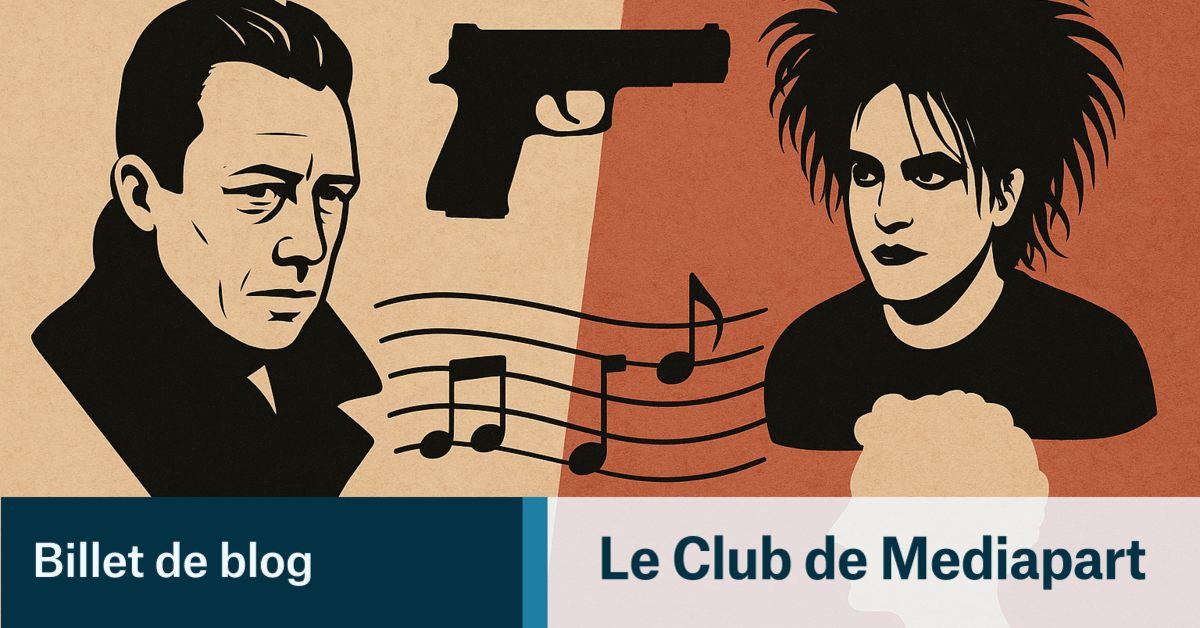
Two readings from the same stranger
Since the release of François Ozon’s film, The Stranger seems to be experiencing a second youth.
Everywhere, we reread it, we debate it, we identify with it.
In France, the story of Meursault remains a metaphysical drama: that of a man facing the absurd, the sun, death.
But seen from Algeria, this same story takes on another dimension – harsher, more political.
There, it is not only the story of a man in crisis, but that of a nameless murder, of an Arab without face or voice.
Two readings for the same novel: one existential, the other wounded.
Perhaps it was necessary to use music to reconcile these two visions.
A salutary, unexpected detour: that of a British song from the 80s, Killing an Arab de The Cure.
It was through her, and not through Camus, that I became acquainted with The Stranger.
A sound encounter before being literary.
The stranger and the radio
The first time Albert Camus was mentioned, I was fourteen years old I think. His name was probably lying dormant in my father’s library, but I didn’t yet dare face those adult shelves. However, it was through a song, and not through a book, that I met him: Killing an Arab de The Cure.
Since Mascara, French radio stations have been struggling. The signal crackled, swallowed by the parasites. At night, however, everything became clearer: less frying, more promises. These waves formed my window on the world — my internet before its time.
It was there that, for the first time, Robert Smith’s hypnotic bass broke through the fog and settled into my memory.
The title, obviously, was shocking.
Kill an Arab — difficult to take for an Algerian teenager.
But the music was immediately fascinating: haunting, almost mystical.
The meaning behind the misunderstanding
Later, by listening to the nocturnal broadcasts, the truth emerged:
Killing an Arab was not a racist provocation.
Robert Smith, then a young reader, was inspired by The Stranger by Camus.
A way of transposing into song the scene of the murder on the beach, this overwhelming sun which blinds the narrator and blurs the border between gesture and meaning.
Standing on a beach
With a gun in my hand
Staring at the sea, staring at the sand…
The song became a literary chronicle in bass rhythm: the absurdity, the solitude, the distance from the world — it was all there.
Smith, having read Camus in French, translated his own fascination with the strangeness of life.
I’m alive, I’m dead, I’m the strangerhe sang.
A direct echo of the dizziness of the novel.
The misunderstood song
However, the irony of fate wanted this song to be diverted.
Misinterpreted, it eventually became an anthem for certain small racist groups.
The Cure suffered deeply.
To avoid misunderstandings, the group often changed the title in concert, replacing Killing an Arab par Kissing an Arab — ironic and tender way to defuse hatred.
When Camus starts to sing
At 20 years old, The Stranger finally fell into my hands.
Disconcerting reading: everything escaped me, except this familiar strangeness.
The memory of the song persisted, giving the novel an inner music.
For a long time, Camus was confused with The Cure – dark, lucid, crossed by shadows and light.
Reread as an adult, the text became clearer, but the song continued to beat louder than the words.
Maybe because she was saying the same nonsense, but at guitar pitch.
The face of modern romanticism
Much later, in the 1990s, the voice took on a face.
The Cure’s clips, strange and flamboyant, colored my musical imagination.
Robert Smith appeared as we had dreamed: stooped silhouette, painted lips, eyes drowned in raining mascara.
Her spidery hair seemed to harbor secrets, her black clothes an interior theater.
He alone embodied the spirit of modern romanticism — that of tired but burning hearts.
This face gave substance to Camus’ philosophy.
Same melancholy of the world, same refusal of the cynical pose.
Beneath his appearance as a tender vampire, Smith sang of the absurd, of loss, of the beauty of ruins.
Camus wrote: “We must imagine Sisyphus happy. »
Smith made him dance — in a red light, between guitar and despair.
Between the ball and the kiss
Since then, between Camus and Robert Smith, I have chosen the second.
Because the first shot the Arab for no reason, and the second tried to repair the meaning.
Because Robert Smith, instead of killing, ended up kissing.
Because he pampered the Arab, turned the ball into a kiss.
And somewhere, between Mascara and Brighton, between the pages of a Parisian novel and the waves of a radio, her voice continues to sing for both of us — the foreigner and the foreigner.
The Arab, always to be defeated
Half a century after Camus, the Arab remains to be destroyed – not on the beach this time, but in speeches, on TV sets, in laws that clench fists.
Always the stranger, always the one we look at sideways, who we suspect of existing too strongly.
In France, we continue to debate The Stranger while naming the Arab in the news, as if literature could wash away history.
But Robert Smith understood before anyone else: we need to change the refrain.
Killing doesn’t clarify anything, kissing repairs a little.
PS/ This text is taken from a collection of musical short stories to be published soon

Hi! I’m Renato Lopes, an electric vehicle enthusiast and the creator of this blog dedicated to the future of clean, smart, and sustainable mobility. My mission is to share accurate information, honest reviews, and practical tips about electric cars—from new EV releases and battery innovations to charging solutions and green driving habits. Whether you’re an EV owner, a curious reader, or someone planning to make the switch, this space was made for you.



Post Comment