The police massacre in Brazil reignites the debate on how to combat organized crime in Latin America
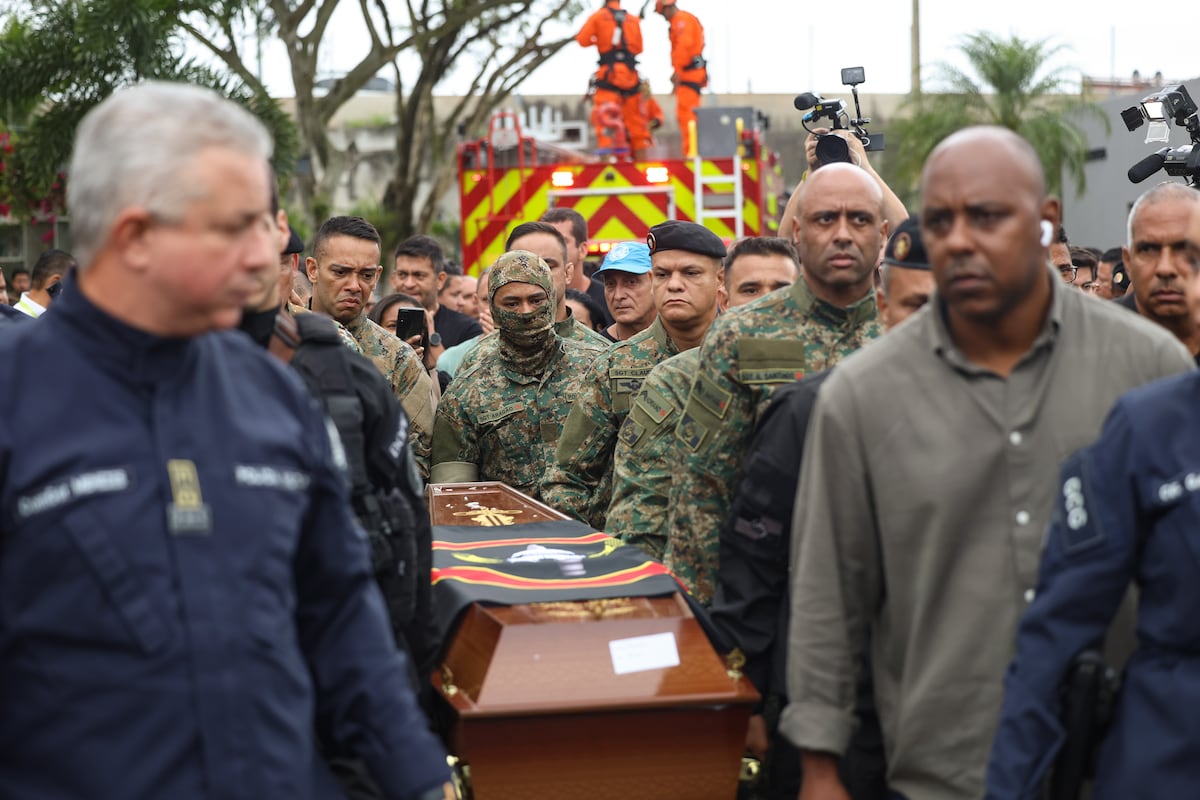
The police operation that left an unprecedented trail of deaths in Rio de Janeiro on Tuesday (121, according to the latest official report) is already the subject of furious political discussion, although the fallen police officers have just been buried. And many favela mothers are still anxiously waiting to locate their children or identify them. Public security is thus placed as the star issue for the Brazilian presidential elections in a year’s time. But the impact of the massacre—one of the worst caused by security forces in Latin America—transcends borders and revives the debate about how to effectively combat organized crime in the most violent region on the planet.
The duel between the supporters of the heavy hand with spectacular blows and the defenders of medium-term strategies more focused on intelligence tasks to economically suffocate the powerful groups that arm themselves like beasts with drug money returns to the center of the Latin American political debate, whether in Brazil, Mexico, Chile… And, specifically, two neighbors, Argentina and Paraguay, have reinforced their borders to prevent the passage of fugitives.
“Rio is alone in this war,” stated the governor of Rio de Janeiro, the Bolsonaro supporter Cláudio Castro, in a press conference on the same Tuesday, when the operation was still open. This “is a war that has nothing to do with urban security,” but is fueled “by the weapons of international drug trafficking,” he added. He criticized the lack of support from the federal government. He also let it slip that perhaps he was asking for help from the Armed Forces and the magic word of recent weeks: “They are narcoterrorists.”
Castro, a Bolsonaro supporter, echoed the speech with which the American Donald Trump has promoted his questioned policy of extrajudicial military attacks against alleged drug traffickers. Since the magnate returned to power, the US Administration has promoted the designation of the large Latin American drug mafias as terrorist organizations.
Faced with criticism from the Fluminense governor, the president, Luiz Inácio Lula da Silva, who was caught by the massacre returning from a tour of Asia, immediately took action. There is no longer any doubt that public security will be the big issue of the electoral campaign for 2026 and Lula has just announced that he will seek a fourth term. As soon as he landed, he gathered his team and announced a coordination commission with the Government of Rio de Janeiro.
The president sent two of his ministers to Rio to closely accompany, this Thursday, the residents of the favelas that were the epicenter of the shootings and listen to the demands of the families who lost one of their own.
While the governor considers that the police operation “was a success” only marred by the death of the four security force agents, the Minister of the Human Rights portfolio, Macaé Evaristo, proclaimed after visiting those affected that the operation “was a failure, a tragedy, an unspeakable horror.” For the minister, “if we want to combat organized crime, we have to start at the top”, with those who rule.
As an example of its recipe to combat organized crime, the federal government has these days contrasted the bloody operation in Rio with one carried out in São Paulo in August. If this week’s attack was against the Red Command, a criminal group that traffics drugs and weapons from Rio de Janeiro, the one months ago was against the only Brazilian mafia that surpasses it in power: the First Capital Command (PCC), a brotherhood of criminals that rewards innovation in its ranks. The Federal Police, with information from the Ministry of Finance and the collaboration of the São Paulo authorities, dealt a decisive blow to the economic apparatus of the PCC. Without firing a shot, he dismantled a network of investment funds that laundered money for the PCC.
Ignacio Cano, researcher at the Violence Analysis Laboratory of the State University of Rio de Janeiro, believes that when the governor authorized an operation of this nature and magnitude against the Red Command in its headquarters “he intended to create a political fact, it was a conscious bet. He knew that (the members of the CV) would paralyze the city in response, that it would generate enormous visibility at the national level and, then, he would present himself as the great champion against organized crime.” With that, Castro has just reared his head in the 2026 presidential campaign in which the right, with Jair Bolsonaro imprisoned and disqualified, has not yet chosen a candidate.
Rio activist Eliane Sousa Silva, director of Redes da Maré, an NGO that works in the homonymous favela, criticizes the state government because it continues with violent incursions into the favelas, ignoring the limits imposed by the Supreme Court, which in April required cameras in their uniforms and demanded that they create a plan to reduce police lethality. This operation “is more of the same, the magnitude changes, but we do not see measures to address the problem strategically.”
Latin America is the deadliest region on the planet, with a homicide rate that is four times the global average. For this reason, public safety is a capital and daily concern for its inhabitants and, with them, for politicians. A study co-directed by Cano, one of the few that has evaluated the wide range of measures implemented in recent decades against violence in the region, has striking conclusions. Placing the army on the streets or eliminating the leaders of armed groups can be counterproductive and increase violence. Limiting the possession of weapons and the sale of alcohol stand out among the most effective measures.

Hi! I’m Renato Lopes, an electric vehicle enthusiast and the creator of this blog dedicated to the future of clean, smart, and sustainable mobility. My mission is to share accurate information, honest reviews, and practical tips about electric cars—from new EV releases and battery innovations to charging solutions and green driving habits. Whether you’re an EV owner, a curious reader, or someone planning to make the switch, this space was made for you.




Post Comment