Way Down East. The cities of the plain

As I write I am listening to some musical tracks signed by Krano taken from the soundtrack of The cities of the plain: the false notes folkobviously intentional, take me back to the dimension of a film that invites me to travel. The path traced by Francesco Sossai’s second work is melancholic, sly, comic; it’s certainly nostalgic, but to an extent that I found enjoyable. It is in this way that, on the threshold of the film, we start together with Doriano, “Dori” (Pierpaolo Capovilla), and Carlobianchi or Charlie White, a sort of brand (Sergio Romano), the Collodian Cat and Fox reincarnated in the Northeast and therefore characterized by the typical sing-song speech, hybridized with dialectalisms and filled with correct blasphemous colorings in the extremeswith the deity degrading to uncle. The film gradually becomes inviting like a mixed fry at a bacaro: inside we find both the failures and the joy of being (still) alive, an essential condition for drinking another one: yet another last one.
Dori and Carlo, inseparable gypsy companions, live within the Veneto as if inside a terrarium, among ruins and unclear memories, in which the only practicable frontier is that of challenging one’s own alcohol capacity. Not only kept plumb, but also kept afloat. The daily goal, a ritual repetition compulsion, is to find oneself at the bottom of the glass before going to bed, to endure the material void left by a fortune that has kissed and spoiled them in distant times. Nineties and then abandoned. Reversing roles and illusions, the Venetian Gatto and Volpe are fully convinced that their friend Genius (Andrea Pennacchi), nomen omenalready the legendary winner of the Caliera Trophy, has buried a portion of the loot (of gold coins?) obtained from illicit trafficking linked to the production of glasses, an expression of the thriving small and medium-sized businesses in the north-east. While they savor a second period of splendor, they leave to welcome him on his return from Argentina, where he had taken refuge while awaiting the prescription. But the two choose the wrong airport, betrayed by an ambiguity motivated by tourist interests which also names the small Treviso airport after Venice. Having ended up in the streets of the lagoon city, they accidentally meet their Pinocchio, Giulio (Filippo Scotti), an architecture student: a southern boy, shy and lost, who joins the journey, finding himself without knowing it inside a modern fairy tale, of which he will ultimately become the unexpected protagonist.
The cities of the plainwritten and directed by Sossai with Adriano Candiago, is a road movie melancholic as well as ironic, set in a Veneto which, although wounded by the excesses perpetrated in the name of economic development, seems to resist with disenchantment, not without side effects. From stage to stage, aboard a Jaguar remodeled as best we can, we move together with the three men, among the dust of the past and alcohol of every type and degree, hearing the lisping language of the taverns but also that of the poets, lost between the concrete of the ring roads and the fog that turns the horizon into infinity. It does not matter, therefore, to ask whether Sossai’s direction is guided by the memory of Collodi’s work or, as regards the moving images, inspired by the manner of his compatriot Carlo Mazzacurati and Aki Kaurismäki, from Veneto in factsimilar in terms of themes and settings. What matters is that The cities of the plain it persists in presenting itself as a map. A treasure map that becomes a sentimental map of a territory suspended between myth and ruin, false memories and new liver challenges.
The tightrope on which the two idlers walk becomes a tightrope, suspended between the ancient civilization of the villa, between Palladian columns, frescoes depicting foul divinities, empty barchesse once intended for the shelter of animals and tools, in the center of green acres that extend as far as the eye can see and which risk being limited by the motorway under construction Lisbon-Treviso-Budapest; and the unfinishedhighlighted by perforated brick constructions, alongside the legacy of the syncretic modernity of Carlo Scarpa, the film’s tutelary deity, reminding us that architectural artefacts, as well as those who commission them, are ruins in anger.
In this labyrinthine Veneto there is both the sublime Brion tomb (which has become set Hollywood, as in the last one Dune), and the votive aedicules kitschcontaining mass-produced statues of saints, very colourful, overloaded with lights and adorned with faded plastic flowers, which superstitiously guard the roadsides. Among these totems and abandoned places unfolds the picaresque journey led by two companions who are too old to grow up and at the same time too disenchanted to stop and take any stock of their lives. Every severe hangover of Dori and Carlo is underlined by the slanted shots, an obligatory point of view that also infects the observer: no one feels excluded from the bacchanal, nor from Pinocchio’s Bildungsroman.
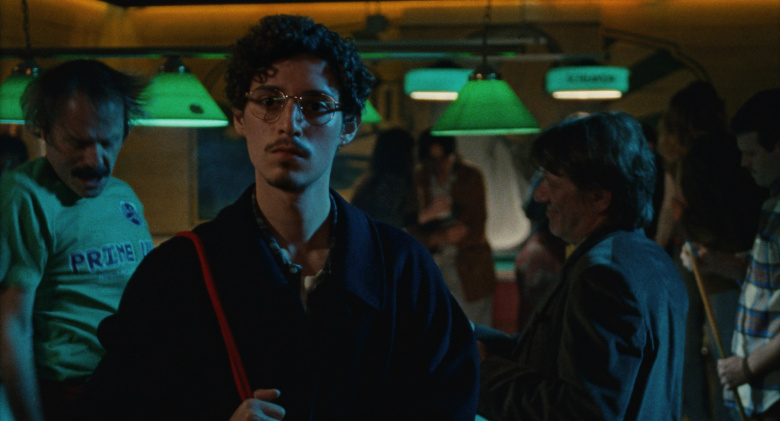
Giulio is lost in a Northeast that he tries to decipher, drawing a map that he himself composes sheet by sheet: a way to root the memories of that adventure, for future reference. Indecisive, fragile, scared, prone to resistance, yet curious and complicit. Dori and Carlobianchi welcome him as two masters of unexpected raids, reversed mentors: alter ego of Lucignolo, to continue the Collodian metaphor. Theirs is not a deception, rather it is a pedagogy of experience, made up of terrible examples but also of sudden revelations. They teach him, without wanting to, that one can continue to live in peace even in defeat, that freedom is an exercise in loss, that there is no greater lie than that of reputation. Inside their patched-up vehicle, albeit of noble origins, between a cigarette and barely disguised blasphemy, Giulio can thus welcome his moral apprenticeship. Each stage of the journey is a small test: hunger, need, lies, fear, sexual initiation and the absolute value of friendship, virile friendship, a clumsy replica of that of the cowboys, made of ambiguity and symbiosis.
If Collodi outlined an education for the puppet through disobedience, Sossai films it through joyful drift. Dori and Carlobianchi do not promise a future, but a shared present; they do not teach the way of good, but that of a courage stripped of pomposity. Their Veneto, from the mountain districts to the cities of the plains and lagoons, is a disused Toyland, but alive in the words of the survivors. Giulio, the embryo of an architect and a man, in this desolate space learns to laugh, to give himself to Epicurean practice and to recognize the beauty of loss.
In the gallery of models for this Far North-East you can recognize flashes of Easy Rider e Fear and loathing in Las Vegasas well as a tribute to The language of the saint by Mazzacurati (to whom Paolo Cottignola, editor of the film, is linked). There is no place for moralism or judgement: old and young guard private vices and disdain public virtues, drawing a separation from the mythical and stereotyped Veneto sketched in films like Ladies and gentlemen (Pietro Germi, 1966) e Commissioner Pepe (Ettore Scola, 1969). There is no need, therefore, to resort to the image of the “bronse coerte”, the embers suffocated by the ash always ready to blaze: the explicit here replaces the usual masks without the need for explanations.
Sossai’s Veneto is a land that seems to be without masters or farmers, where progress has moved on board bulldozers, leaving construction sites and new upheavals. It is the North-East nourished by entrepreneurial myths which can be recognized in the rolex given by the owner to his retiring worker, with a subtext linked to the preciousness of time, but which is the prelude to a gambling annihilation victim of slot machine. A Veneto of escapes abroad, of Italian cunning and inglorious exile. A place where destinations count more than maps, where El Dorado, perhaps, has never existed except in the alcoholic memory of the singers of carefree youth. A world that has become unexpressed, left half-finished, where the old surviving taverns resist alongside the identical shopping centres.
In this kaleidoscopic context, where past and future float within yet another shadow of vinGiulio is a son that no one expected, but that his strange mentors recognize as such and adopt. The visit to the cities of the plains is part of the educational practice: at the end of the journey Giulio does not become a hero, just as Pinocchio does not become one, but he is emancipated from his own idiosyncrasies. And his irregular teachers, the Cat and the Fox, are not punished, on the contrary: they continue to drink, to philosophize and to mock morals and the passing of time. But it is in this paradox that the film blossoms: it is the doubt that gives us yet another day to live and with it another glass to consume.
Here too, as in many Venetian cinemas, the landscape And character; therefore, the highway being built becomes the symbol of an imaginary progress. Sossai films all this with rare modesty, defusing the risk of the indignant pose with irony, alternating moments of the grotesque with lyrical glimpses that conquer. His north-eastern characters seem resigned, but unconsciously retain the echo of Andrea Zanzotto’s critical gaze and the corrosive disenchantment of Vitaliano Trevisan. Theirs is the testimony of an internal landscape that sometimes generates aphorisms to be preserved for future reference. Giulio observes and listens. He too, with us, is a spectator of the film: the bearer of a gaze that studies the disillusionment embodied by the two geeky mentors, despite the antics, even risky ones. In his shyness ours can be reflected, in his indecision the stalemate of a generation in search of myths.
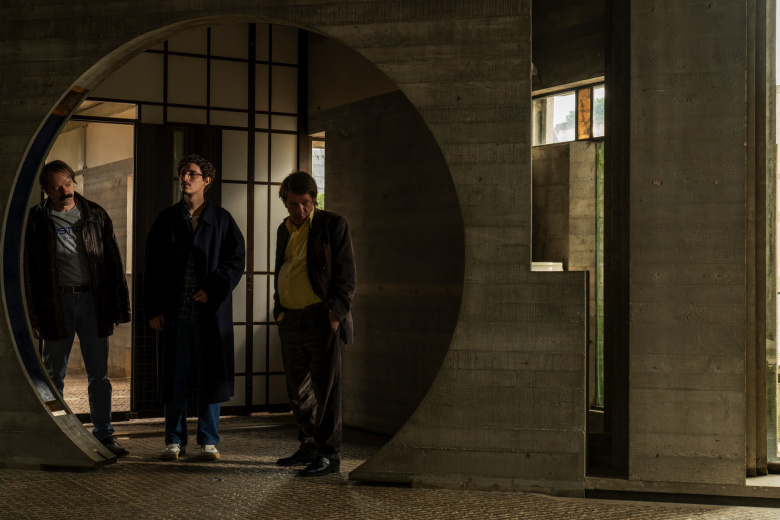
He must learn to distinguish the voices: that of the Talking Cricket (conscience, duty) and that of the Cat and the Fox (freedom, error). Only by losing himself in the funny lie will the boy understand a possible truth: that life does not redeem, but consoles. It is then that the fable suddenly turns into an elegy. At the same time the two Ulysses discover that the stages of their youth journey present themselves today in the form of rubble, closed taverns, empty warehouses, in short: a cemetery landscape. And it is precisely the Brion tomb that marks the border between life and memory, between East and West, between art and ruin. It is the arrival point of the journey and at the same time its proclaimed failure: the only place where the three protagonists finally find peace, sitting on the edge of a tub, talking about nothingness as if it were eternity.
Sossai, in short, neither judges nor absolves: he observes and stages. And in his gaze you can feel it piety of those who love what they tell. Giulio, on the other hand, carries within him the echo of millions of young people who left the South to realize their future in the North; Dori and Carlobianchi represent what remains of that dream: two consciously funny figures, who hold up their own fairy tale with the strength of irony, while Giulio learns to look at the world and his own future with less fear. He does not become a perfect man, but a possible man. And perhaps this is why, ultimately, the film presents itself as an inverted coming-of-age story, even in terms of values, where the masters are lost and the disciple survives thanks to their imperfection.
In the distracted step and in the silences, The cities of the plainspeaking of Veneto, can also tell the profile of an entire country which, like Pinocchio, continues to look for the way home imagining that it will never really find it. But it is precisely in that journey, in the attempt to overcome the ancestral thirst, that his fragile, irreducible humanity lies. Like Collodi, Sossai describes an initiatory journey: Giulio, the puppet who comes from elsewhere, learns to drink alone thanks – or because of – two apparently failed adults who remained in the larval stage who have the ability to guide him towards the disillusionment contained in the couplet “We know nothing. But we know everything”.

Hi! I’m Renato Lopes, an electric vehicle enthusiast and the creator of this blog dedicated to the future of clean, smart, and sustainable mobility. My mission is to share accurate information, honest reviews, and practical tips about electric cars—from new EV releases and battery innovations to charging solutions and green driving habits. Whether you’re an EV owner, a curious reader, or someone planning to make the switch, this space was made for you.


Post Comment